 Log In

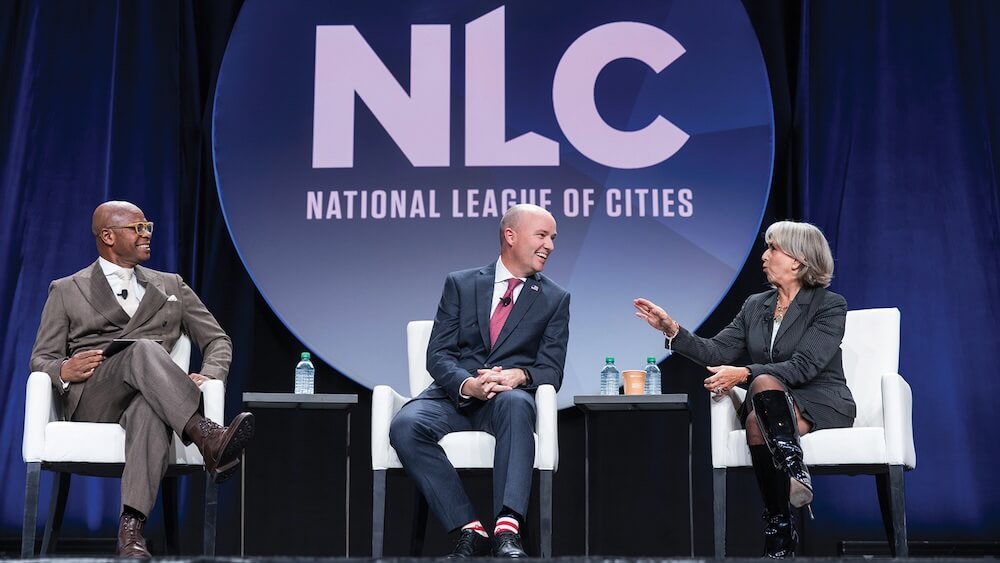
NLC’s Clarence Anthony (left), moderated a conversation between Gov. Spencer Cox and Gov. Lujan Grisham, who talked about — and demonstrated — how to engage in a healthy debate with respect.
While “Creating Opportunity in Uncertainty” was the stated theme of the National League of Cities (NLC) City Summit 2025, Nov. 20-22, a sentiment of a more certain nature found a foothold among the 3,000 local government leaders at the conference in Salt Lake City, Utah: The need in our polarized society to return to civility in our conversations and to treat one another with respect instead of contempt when we disagree.
Janice Pauline
‘We just need it to become this whole social movement.’
Looking back at the program, designed to help participants build leadership skills and gain strategies to support their work in their communities, Janice Pauline, NLC’s director of business events, said that there were two linked segments in one of the conference-wide general sessions driving home this point that she found to be the most “timely and relevant we’ve ever done for city officials.” Participants backed up her assessment by voting with their feet: standing ovations for the sessions and standing-room-only for follow-up workshops.
The first segment was a presentation by Timothy Shriver, cofounder of the Dignity Index, a tool to rank the level of respect we convey when we communicate, followed by a “Disagree Better” panel discussion between Utah Gov. Spencer Cox and New Mexico Gov. Michelle Lujan Grisham, moderated by Clarence E. Anthony, NLC’s CEO and executive director. The two governors from different parties have tried, publicly and privately, to model how to respectfully disagree on important issues.
RELATED: ‘Disagree With Ideas, Don’t Dehumanize People’
Gov. Cox is a Republican and Gov. Lujan Grisham a Democrat, “but they are like, ‘Hey, we don’t agree on these things, but we can agree on these things. A lot of what we don’t agree on is the way forward. We just have to work with each other and keep having the conversation to see if we can come up with something that makes sense,’” Pauline said. “It goes back to basic conflict resolution principles and negotiation. It takes a lot of conversation and a lot of work, but you don’t get to ‘yes’ by saying, ‘You know, you’re completely wrong.’”
Gov. Cox launched a “Disagree Better” initiative as his platform during his time as Chair of the National Governors Association in 2023, to counter polarization and foster a positive way to work through shared problems. In this work, carried out through public debates and service projects, he has seen that “Americans are tired of us hating each other,” according to a recap of the panel by Deseret News. “They hate what’s happening in politics right now.” He underscored the power of the audience to lower the temperature. “You are the front lines,” he said. “You have the ability to show people that everything does not have to be politicized, that we can actually work through our differences.”
Setting the Stage
Pauline said the idea to have Shriver present at the summit came from Utah’s municipal league director — every state except Hawaii has a municipal league that lobbies their state for their municipal governments, she explained. Since NLC’s summit would be held in 2025 in Salt Lake, the director recommended that they try to get Shriver, who has been working on the Dignity Index initiative at the University of Utah, as a speaker. When the index’s co-creator, Tami Pyfer, who is a local resident, spoke with NLC about it, she was really interested in the opportunity, considering “it’s a great audience for their work,” Pauline said. “It all just came together.”
It was announced at the end of Shriver’s session that NLC would be partnering with the Dignity Index, potentially through training modules, which Pauline said helped fuel interest — “people were really intrigued” — in a follow-up workshop the next morning. The workshop aimed to help them use the tool “in their work and how they’re running their own city government office as well as how they’re communicating out to their citizens,” she said.
While Pauline is optimistic about the Dignity Index taking hold among local municipal leaders, she thinks the message has legs for many other sectors — including the events industry. “I think about … meeting professionals across the country as one group, but then it’s all the associations and the people they represent. How do we as a professional group,” she said, further this movement? Planners have “a significant amount of influence over what is communicated to all these different sectors through the people we bring onto our stages to speak at our conferences. What are the messages that our association is wanting to put out?”
Pauline also said the index can be used as an approach in daily professional interactions. “Personally, as a meeting planner, I work to be at a five or higher,” she said, referring to its eight-point scale. “Especially when I’m working with some of my vendors or the hotel staff who may have just made a mistake or executed a plan that is different from what I thought I had communicated. What is my score on the index in this situation? It’s also relevant as I think through the content of my meetings, what we are saying to our members as city leaders, and what they’re taking back into their communities.
“There’s a huge potential for a ‘Dignity Revolution’ and the Dignity Index team is really getting people excited, and then with the governors and their Disagree Better initiative, it feels like all are moving in the right direction,” Pauline said. “We just need it to become this whole social movement because I feel like our democracy and our country is kind of at stake if we normalize contempt and a winner-takes-all mentality as the way to get things done.”
 Subscribe to Convene.
Want deep-dive insights on events delivered to your inbox? Sign up for our newsletters
Having an Impact
“Meeting planners have to understand they do have substantial influence and power over what is communicated to their membership,” Pauline said, referring to their role in creating civil and respectful gatherings. But beyond that, she has been able to connect how conferences make a broader positive impact in the world, citing two examples of how participants’ experiences at NLC have shaped the communities they serve.
“I remember one of the people who became president of our organization said that at the first NLC conference he went to,” she recalled, he had chatted with someone else eating lunch in the exhibit hall, a mayor who shared that his town had just gone through a 100-year flood. While the conversation interested him, he didn’t find it relevant for him, as he served as the mayor of an Indiana town with a small river that had never flooded.
“They exchanged information, and two years later, all of a sudden, he’s got his 100-year flood, and he had — back in the day of business cards — the man’s card, and he called him up,” Pauline said. The mayor told him the three things he needed to do right away, including declaring a state of emergency. “That one phone call saved him well over $1 million” in recovery efforts, she said. He said that was the most incredible lunch at an exhibit hall he’s ever had. It’s those connections — you just don’t know when you’re going to meet ‘that’ person.”
As they do the work of keeping their towns and cities running smoothly, NLC participants also take more of an interest in the conference’s host destination than other kinds of eventgoers. Pauline recalled that at her first conference with NLC in 2002 — also in Salt Lake — she walked across the street with then-Mayor of Washington, D.C., Anthony Williams. The city had just completed a pedestrian-friendly initiative because it hosted the 2002 Winter Olympics. “Salt Lake has very big, wide streets,” she said, and Williams commented on how brilliant it was for the crosswalks to have countdown clocks so you knew how much time you had to walk across the street before the light changed.
“I’m just walking across the street with the mayor of D.C.,” she said, “not thinking much about his comment and then about a year later, every crosswalk in D.C. had a countdown clock. I’m just like, ‘Yes! I was with the Mayor when he got this idea. This conference, what I do for a living, makes a difference for people.’”
Michelle Russell is editor in chief of Convene.
Bridging Our Divides
This article and those listed below are part of Convene’s February 2026 issue cover and CMP Series story package.