 Log In

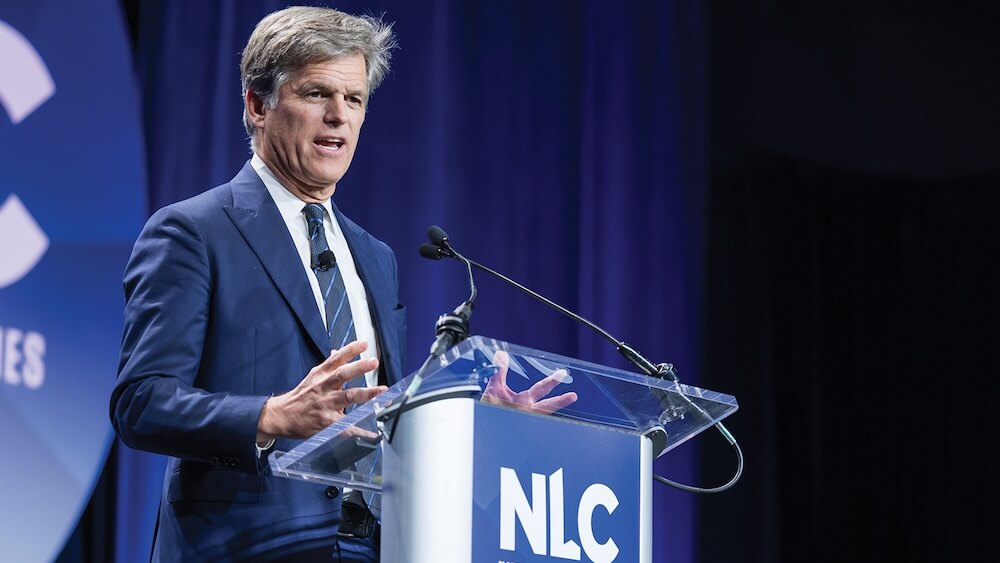
Timothy Shriver asked participants to consider the importance of how people treat each other at last fall’s National League of Cities Summit.
Timothy Shriver, son of Eunice Kennedy Shriver and Sargent Shriver, has had a variety of roles — disability rights activist, film producer, former educator — and has served as Chairman of the Special Olympics for the past three decades. He most recently founded the nonprofit UNITE, with the goal of reducing societal divisions and fostering national unity by promoting productive dialogue, empathy, and human dignity. One of UNITE’s resources is the Dignity Index, which he co-created as a tool to measure how people communicate during disagreements, from contempt to deep respect. He speaks at conferences, gives workshops at universities and companies, and works with government leaders to “help us escape the contempt industrial complex that feeds us a steady diet of outrage, dehumanization, and despair,” he wrote in a recent blog post.
At last fall’s National League of Cities City Summit, Shriver asked the audience of local government officials to consider that “there is a new issue amongst us in our country. It’s not immigration. It’s not education. It’s not policing. It’s not emergency management. It’s not taxes,” he said. “It’s how we treat each other.”
RELATED: Scaling Dignity
When Convene recently spoke with Shriver, he was quick to point out early in our conversation the role the events industry can play in creating spaces of constructive dialogue and shared human dignity, not often found in public discourse. Event organizers “are people who work together to create convenings where we tell stories,” he said. “What’s a keynote address or a panel discussion or a video montage wall or an exhibit space other than a version of a story of a particular community?
“These convenings are our chance to elevate the stories of people who are bridging, who are listening, who are exercising some degree of humility. What is a scientist if not someone who has some humility about the idea they’re testing? They are open to the idea that they don’t know the answer. That’s how science gets done. What’s great education but the inquiry and the lead to that which you do not yet know? What’s great politics other than the inspiration of people to do things they didn’t think were possible? In convening leaders who convene other leaders, we’re inviting people to see a version of themselves, a story of them — this story is out there. We just don’t hear it enough. You all can help us tell it.”
Here’s what else Shriver had to say about his initiative to make our conversations more humane.
How did you land on dignity as the focus of your work?
All of us as human beings [are] all endowed with a certain inalienable — to use the language of the Declaration [of Independence] — dignity. It’s something we’re given. We don’t earn it. We can’t lose it. It can’t be taken away from us. We can feel like our dignity is violated, or we can feel like we’re violating someone else’s dignity, but you don’t give anybody their dignity, and they don’t give it to you. You got it. It’s universal, and it’s inviolable.
This idea is not new. This comes from spiritual traditions. It comes from psychology. It comes from great politics. It’s not universally welcomed and accepted as an idea, but it’s definitely not a new idea. Our interest, the interest of those of us who came together to form the Dignity Index, was triggered a little bit more by the sense in our country that maybe we were missing out on the importance of this insight that everybody has dignity, that maybe we’ve gotten so trapped in the cycles of contempt and outrage and being rewarded for humiliating and dehumanizing other people. Maybe we had lost track of this fundamental insight.
I learned it to a large extent from the athletes of Special Olympics. It’s not something I taught them. It’s something they taught me: that when people are treated with dignity, you get extraordinary outcomes. Someone who doesn’t talk, talks. Someone who can’t run, races. Someone who doesn’t know how to bounce a ball makes a three-point shot, and everybody goes, “Wow, what happened?” What happened was you gave them a chance. You listened. You waited. You supported. You stayed the course. You stayed in relationship long enough to let that person’s dignity shine through.
Others of us came to the work from politics, some from education, some from religion, some from teaching…. Whether you’re a Republican or a Democrat or conservative or liberal or centrist or whether you come from the heartland or the coastland or whether you identify by one or another geographic or ethnic or cultural, or racial backgrounds — it’s about learning how to treat people with dignity, no matter what.
What impact has the normalizing of contempt had in our daily lives?
[We are] seeing the effects of the normalization of dehumanizing other people — in tearing our families apart, seeing the effects in paralyzing our capacity to solve problems, and maybe most painfully seeing the effects in the emergence and the resurgence of violence. Violence against people like anti-Semitism and racism, violence against political opponents … and threatened violence. The list goes on and on.
We try to make a distinction between disagreeing with an idea and dehumanizing a person. In order to disagree with an idea, sometimes we slip into the concept that if I really disagree with you, I should prove what a jerk you are, how horrible you are, how bad your background is, how distorted your thinking is, how hard your heart is. That doesn’t actually do anything in our view to advance an idea about a program or a policy or an outcome or a principle. All it does is distract from a difference of opinion.
We like to say, disagree with ideas, don’t dehumanize people. We find in our work that the most exciting conversations are conversations where we watch people disagree about principles and programs, and outcomes, while treating each other with dignity. We’ve seen this with our governors’ conferences…. where a liberal and a conservative [are] on the stage together. They’re talking to each other. They’re disagreeing about vouchers for schools or about the death penalty or about funding for infrastructure.
They’re disagreeing about these things, but they’re saying, “I like this [person]. I respect this [person]. I value his or her service to the country.” It’s riveting to people. They had forgotten that this was possible, that to love and care and value someone is not the same as to agree with them.
We like to say we’re not asking people to agree with each other. We’re not asking people to relax their principles. We’re asking people to add a principle. When you disagree with someone, treat them with dignity. That’s the principle that’s missing. It’s not to become a centrist or become nice or pretend like you don’t disagree. Quite the contrary. To disagree vehemently, vigorously, with passion is great, wonderful. I encourage it. I encourage it in my kids [Shriver is a father to five] and in myself.
What about when you’re dealing with misinformation?
Learn how to marshal facts … to evaluate evidence freely, openly, fairly. If someone says, “The sky is yellow, and the sun is blue,” I think we all have to take a deep breath and maybe start with, “Tell me more. Where did you learn this? How did this come to be your version of what you’re seeing?” Maybe sometimes just by listening, people find themselves, “I believe this because everybody on my team says it,” or “Because you guys think the opposite.” A lot of times, it’s just a defensive position when we’ve distorted facts.
We do have to be hard-nosed about what actual evidence is and where fact patterns lie. It doesn’t mean we’re going to agree on them all, but we should be able to find enough respect for each other that we can challenge the facts without dehumanizing the person.
This is not a right- or a left-wing thing. On both sides of the political aisle, people [can] get trapped in arguing for a version of reality that might not have as much evidence to support it as one would like. I think it makes it easier for people to talk about facts and policies and outcomes when they don’t feel they’re going to be dehumanized by the other side….
 Subscribe to Convene.
Want deep-dive insights on events delivered to your inbox? Sign up for our newsletters
When it comes to serious and life-changing outcomes, we have to be quite tough on each other. We’re all living in information bubbles. A role model of mine, [political commentator] Van Jones, says, “Don’t be deceived into thinking everything in your [social media] feed is true, and everything in the other person’s feed is a cult.” As he would say, “What are the chances of that?” We’re all trapped in communities of self-reinforcing narratives. Those can often lead to distortions of fact in pursuit of reminding us how smart we are and how stupid other people are. That’s trapping all of us. We’ve all got to break out of that. [The social media] algorithm seems to consistently try to drag us down into lower and lower levels of contempt. It seems to reward us when we treat each other in dehumanizing ways. It seems to punish us when we treat each other with dignity. That is something I think we all need to oppose.
Where have you seen the most interest in the Dignity Index?
Corporate leaders are more interested in this than political leaders. I think in a way, it makes sense. What are corporate leaders trying to do? They’re trying to create a culture, a culture that’s efficient, that’s effective at getting the best out of everybody, where teams operate in healthy and collaborative ways, a culture where leaders empower other people. That’s all dignity-based work. Teambuilding requires dignity. Servant leadership requires dignity. Problem-solving requires that we treat each other with dignity.
Corporations are very clear that if the world out there is contemptuous, the vast majority of business leaders don’t want a contemptuous culture within their business. They may want to compete against other businesses, but they don’t want people to be treated with contempt in their businesses. We’ve probably trained and worked with more people in business than we have in any other line of work. We’re very excited about that.
Are you feeling like you’re making progress?
We believe that cultures change when subcultures grow up that are different from the mainstream culture. When you’re trying to change the mainstream culture, whether it’s the civil rights movement or the women’s movement, any culture change movement, it almost always starts with countercultures. People see, “Oh, what are those people doing? That seems different over there. In that town, in that school, in that company, look at how they act. Let’s try to figure out what they’re doing so we can do it too.”
It’s a culture of attraction. We’re trying to create countercultures. It sounds grandiose in some respects, but that’s what I think convening does. You say, “Let’s have everyone come together for our annual [conference] so that we can empower you, strengthen you, give you the tools, the inspiration, the excitement, the learning to go back and sustain a culture…” whether it’s scientific or educational or political.
We’re looking to create communities, [for people to] join conversation groups, share what’s working, share what isn’t. This is not a straight line. We get invited into this conversation around how we treat each other. We take two steps forward. A lot of times, if we’re honest, we make mistakes, and we slip backwards, and then we try again. That’s what we’re trying — to get people to join us and share your story. What worked for you, when you were talking to your kids or your spouse or your colleagues at work? We’re looking for that … shared sense of practice.
When I was researching your work, one of my favorite quotes about the Dignity Index came from someone who said that their best and happiest surprise was how people who started using the Dignity Index thought they were getting a tool for judging others, but found it was a mirror for seeing themselves.
What people find is like, “Oh my goodness, look at me. Look at me when I’m at my best, but wait a second, yesterday, wow, I was using a lot of contempt when talking about this person or that person.” Almost invariably, when we see ourselves using contempt, we want to do better. The goad to improvement doesn’t come from being scolded or told by me or by someone else; it comes from within.
The Dignity Index
Ease Divisions, Prevent Violence. Solve Problems
8
“Each one of us is born with inherent worth, so we treat everyone with dignity — no matter what.”
7
“We fully engage with the other side, discussing even values and interests we don’t share, open to admitting mistakes or changing our minds.”
6
“We always talk to the other side, searching for the values and interests we share.”
5
“The other side has a right to be here and a right to be heard. They belong here too.”
4
“We’re better than those people. They don’t really belong. They’re not one of us.”
3
“We’re the good people and they’re the bad people. It’s us vs. them.”
2
“Those people are evil and they’re going to ruin everything if we let them. It’s us or them.”
1
“They’re not even human. It’s our moral duty to destroy them before they destroy us.”
Michelle Russell is editor in chief of Convene.
Learn more about the Dignity Index.
Bridging Our Divides
This article and those listed below are part of Convene’s February 2026 issue cover and CMP Series story package.