 Log In


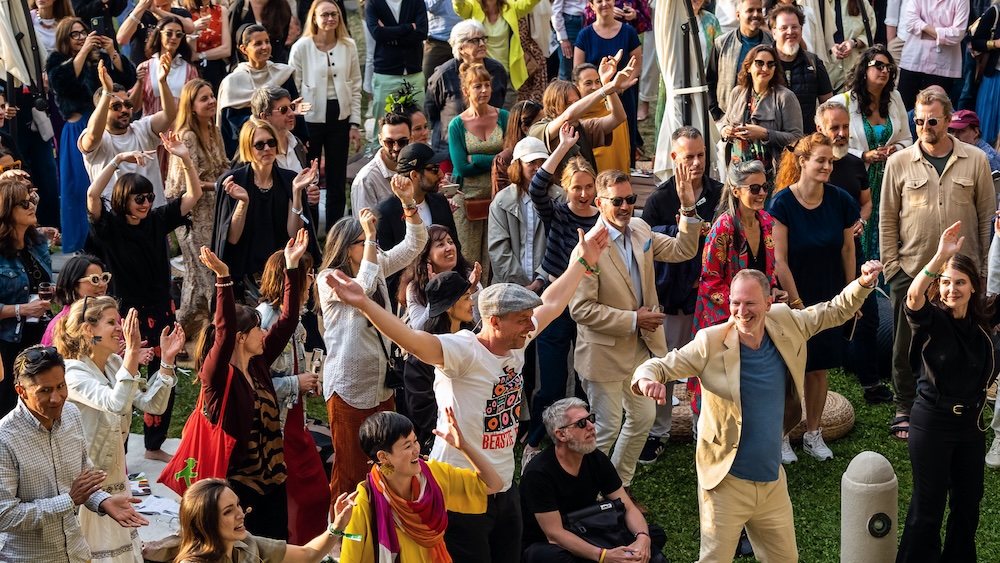
Co-founder Tim Leberecht, lower right in a yellow suit, at the World Beautiful Business Forum in Athens. Leberecht created the House of Beautiful Business to explore ways to add more emotion, adventure, and beauty into modern work. Photo courtesy House of Beautiful Business.
In his 2015 book, The Business Romantic, Tim Leberecht, then the chief marketing officer for a global design and architecture firm, argued that the way we do business — placing value only on what can be counted — was draining work of the mystery, beauty, and emotional depth that give life much of its meaning.
“Humans are first and foremost social and emotional beings,” Leberecht wrote. With so much of our modern lives blended with work, we suffer “when we create false distinctions between our business personas and the other, larger parts of our humanity, and divorce business from our emotional, intellectual, and spiritual needs.”
How, he asked, “can we bring some of the ‘art of life’ back into our everyday business?”
Leberecht ends The Business Romantic by inviting readers to email him if they wanted to join “a secret global network” of like-minded people to meet to exchange stories and ideas. To his surprise, many did. Today, the network that has grown from that invitation — known collectively as the House of Beautiful Business — is a global community of 30,000, including members, digital subscribers, and participants at events produced by Leberecht and his business partner Till Grusche, who co-founded the House of Beautiful Business in 2016. The following year, Leberecht and Grusche gathered 100 people in a house in a medieval neighborhood in Barcelona for a pop-up “House Zero” event alongside Mobile World Congress, one of the world’s largest technology meetings. The pop-up included conversations about technology, society, and business integrated with live opera, poetry and experiences including a candlelight dinner where participants connected with one another solely through nonverbal communication.
Since then, the House’s flagship gatherings have been held in Lisbon and Sintra, Portugal; Tangier, Morocco; and in 2025, across four cities — Tangier again, Berlin, New York, and Istanbul. This past May, the World Beautiful Business Forum, held in Athens, marked the organization’s 10th anniversary and brought together 1,100 people from more than 50 countries and, across a variety of sectors, industries, cultures, and disciplines.
As the cradle of Western philosophy, Athens was “the perfect host city,” Leberecht said, for the questions that were raised at the Forum, subtitled “the most human gathering for a more-than-human world.” Against a global backdrop of AI and crisis, “it’s a good time to think about what it means to be human and philosophize again and ask all the big questions,” he said. “What is beauty? What is truth? How do we want to govern? What is a good life? Those questions are more pressing than ever.”
The Forum offered more than 130 sessions organized into 10 tracks, including AI, philosophy, longevity, sustainability, belonging, and “The Beautiful Business School.” Greek history and culture also helped shape the event — The Olympia City Music Theatre “Maria Callas” served as the event’s main stage, where sessions were presented as five acts, inspired by the structure of ancient Greek drama. Additional venues in central Athens included the Demos Center of the American College of Greece and the Old Athens Stock Exchange, as well as smaller venues throughout the city, including artists’ studios and a tiny bookstore where participants met one-on-one.
A multipart “Democracy Marathon” combined sessions and curated walks that added up to 42.2 kilometers, or 26.2 miles, the historical distance from Marathon to Athens that inspired the modern Olympic marathon, where legend says a Greek soldier ran from in 490 B.C. to share the news of Athens’ victory during the first Persian invasion of Greece.
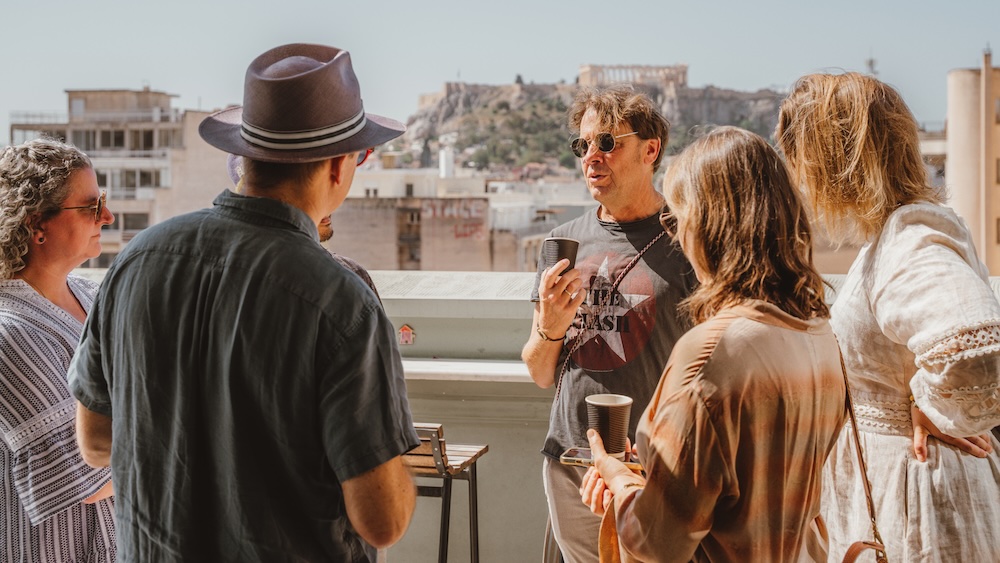
In Athens, participants “speed-dated” contemporary philosophers, including Christoph Quarch, in view of the Acropolis. Photo courtesy House of Beautiful Business.
‘People Are Having a Lot of Fun’
“The people who come here want to forge relationships and take part in interesting conversations,” but that doesn’t mean that they are all super intellectual or academic, Leberecht said. “People are having a lot of fun.”
There was a “Morning Beauty Shake” — “part dance floor, part ritual, part joyful refusal to take yourself too seriously” —a picnic in the National Garden, dance walks, and opportunities for participants to create art with a robot.
One surprise hit, Leberecht said, was a “Philosophical Speed-Dating Rave,” which took place at a rooftop bar overlooking the Acropolis. At the event — which included a DJ — 100 participants rotated in small groups among 10 philosophers, asking “deep questions,” over the course of 10 minutes, Leberecht said. It’s a good example of what the House of Beautiful Business does, Leberecht said, “taking joyful, gamified, entertaining formats, and connecting them with serious matters and real, authentic inquiries into issues that not only matter in business but in our lives.”
Good Friction
With sessions spread throughout central Athens and beyond, the event asked participants to navigate between multiple venues. Most were a 15- to 20-minute walk apart, but others were Deep Talk In Athens, participants “speed-dated” contemporary philosophers, including Christoph Quarch, in view of the Acropolis. further afield. Maps and program guides were available through a web-based portal, but there was no event app. The friction that resulted from requiring participants to make their own way was intentional, Leberecht said.
Some friction at events is just a nuisance, like a bad check-in experience or overly loud music that prevents conversation, but “most things in life that are meaningful have a lot of friction in them,” he said.
That’s why the World Economic Forum takes place in a remote snowy village in Davos, why people go to Burning Man and defy the conditions there,” he added. “And that’s why we have eight, nine, 10 venues and require people to walk and bump into each other and make an effort.”
House of Beautiful Business events also don’t shy away from experiences that elicit feelings like grief and shame, which often are considered taboo in business, Leberecht said. In 2023, a gathering held in Sintra, Portugal, opened with a death doula who guided a small group of participants through a living funeral, where they wrote their own obituaries and meditated on them. “It was a very profound experience,” Leberecht said. “We thought you cannot talk about what we call the life-centered economy if you don’t talk about death.”
At another gathering, held in a warehouse in Lisbon in 2021 on the eve of the COP26 United Nations Climate Change Conference, a session included an 8-year-old girl from South Africa who challenged the 750 adult participants to come up with one single action they would all agree to take. Participants “ended up in a shouting match,” as groups and ideas competed with one another. “They could not agree,” Leberecht said. “They failed her.” It was a real moment of humiliation and shame for the participants, as well as a cathartic moment where participants questioned themselves, he said. It is an example “of how we like to set social and emotional experiments in motion that can teach us about the psychology of business and the relationships that are underneath it all.”
 Subscribe to Convene.
Want deep-dive insights on events delivered to your inbox? Sign up for our newsletters
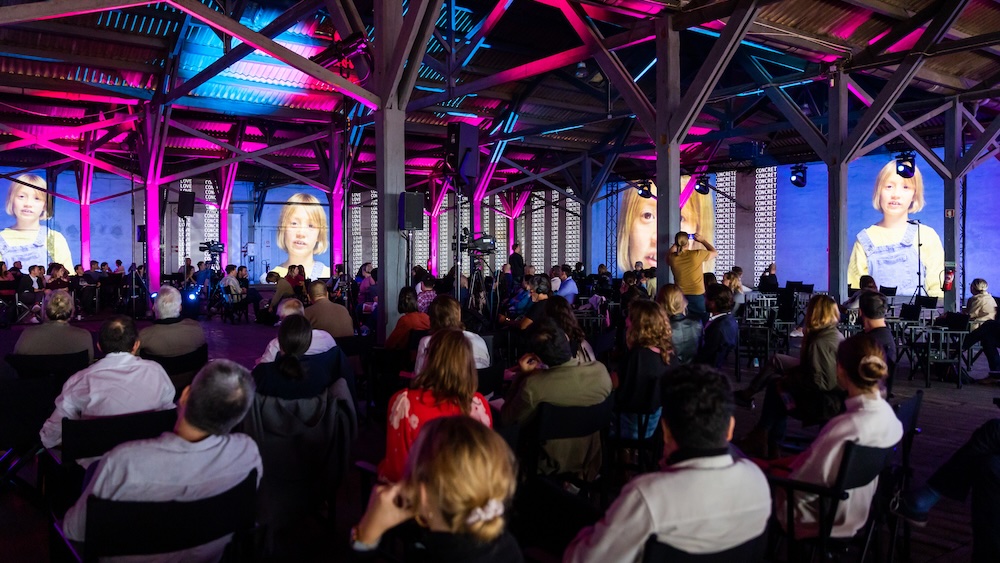
An 8-year-old girl challenged participants at a 2021 House of Beautiful Business event in Lisbon to agree on a single environmental action they would all take. The audience failed. Photo courtesy House of Beautiful Business.
A Swan Song for Humanity?
One change that Leberecht has noted in the past decade is that the House of Beautiful Business gatherings have become more political.
“Given the times we live in, there’s a feeling that we need to take a stance or allow for these conversations to be more heated, maybe, than they were in 2017. Participants are concerned about existential threats [posed by] AI and there’s a lot of grieving by workers who are feeling the loss of their status, their identity, and their agency. They’re very afraid of what’s to come.”
As the World Beautiful Business Forum approached, Leberecht himself had been less than optimistic about what would surface in the exploration of humanity’s relationship to AI. He went in thinking, “maybe this is, in a way, a very beautiful swan song for humanity.”
“And I went out of it thinking, no, no, no! We are so not done yet. There was so much humanity on show, and there was so much energy. We all realized we humans are so in love with each other. We’re so fascinated by other humans, and there’s such a desire for intimacy and connection — for deep authentic connection. And there’s such a need for that and that made me very hopeful.”
“I think maybe our mission has become more urgent and more relevant and that there’s more idealism and energy behind it than there was when we started, ironically,” he said. “The House of Beautiful Business started as a passion project. And now it is our life’s work.”
Transaction-less Business
Organizers signal early on to participants at House of Beautiful Business events that things will be done differently than at most business events, said Leberecht. The message is: “It’s a space that is brave, safe, and welcoming, and you can be vulnerable here,” he said.
One example is the absence of name badges with titles, which lets people know that they “don’t need to play a role or show up as a business professional, they can just be themselves,” he said. When you see a badge in front of you that says “CEO,” “it’s a different conversation than with an intern or artist or shaman,” he said. “We don’t want conversations to be transactional. We want people to meet through genuine connection and conversations about the programming, not about their roles or affiliations.”
The House also does not have an event app or plan to have one for similar reasons, Leberecht said. “I have not seen a social networking app that created real connection — [they’re] transactional,” he added. “We rely on people to connect themselves,” he said, which many do through a “very active but informal” WhatsApp group. The House of Beautiful Business is more interested in creating lightly facilitated “micro-formats” such as dinners throughout the year where members of a community can connect easily, he said. “I think they work better than any app.”
Barbara Palmer is Convene’s deputy editor
Read more about the World Beautiful Business Forum and the House of Beautiful Business.