 Log In

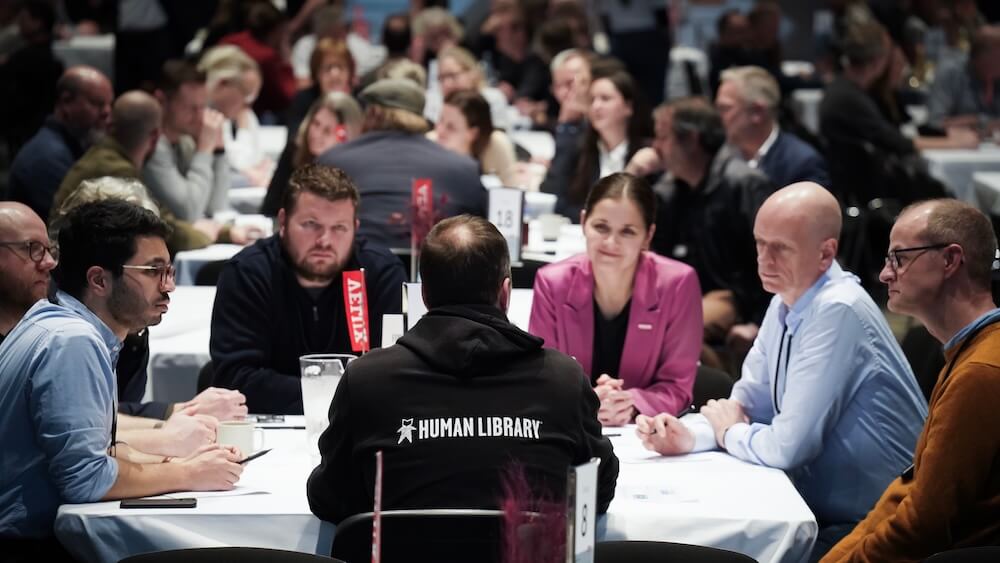
A ‘book’ speaks with ‘readers’ during an event for Danish manufacturing company Velux, which featured more than 25 human books for 500 employees in 2024. Photo courtesy VELUX
Albert Einstein once famously said, “The only thing that you absolutely have to know is the location of the library.” For 26 years, Ronni Abergel has helped people find their way to a wealth of knowledge — and a change of heart. Only in his model, those learnings aren’t found on dusty bookshelves but borrowed from the living, breathing world.
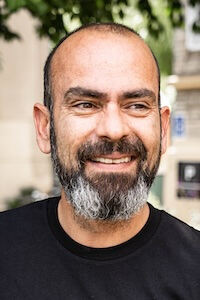
Ronni Abergel
In 2000, Abergel, a Copenhagen, Denmark–based social entrepreneur, co-founded Human Library as a not-for-profit learning platform in which people serve as living “books.” By sharing their lived experiences with “readers,” i.e., curious humans, these books challenge stereotypes. Encounters are meant to foster empathy, respect, and understanding for people who have been marginalized by society — the tagline for Human Library is “unjudge someone.”
With books in more than 85 countries across six continents, Human Library has been incorporated into conferences, leadership events, corporate meetings — including events hosted by eBay and LEGO — and public gatherings, like the Library of Congress National Book Festival in Washington, D.C., last September. Readers also can check out books from Human Library and access them via online video calls.
At events like Burning Man, Danish music festival Smukfest, and the U.K.’s Wilderness festival, Human Library operates as a kind of pop-up “shop” — participants can sign up at a desk for a 30-minute reading with a human book on a particular topic area. They then can extend the conversation longer if no one else is waiting to meet with that person.
“But in the corporate and conference space, everything is locked and tight. There’s a run of show,” Abergel told Convene, for a structured learning session called a “Reading Hall.” A menu of books represents diverse life experiences and perspectives, including those of refugees, people living with mental health conditions and disabilities, LGBTQ+ individuals, and formerly unhoused people. Instead of listening to a presentation, event participants sit around tables in small groups and converse with a human book. In those safe spaces, readers can ask the questions that might not have felt comfortable to ask in other environments, Abergel said, which guide the conversation.
Lending and Learning
The Reading Hall can start with a five-minute welcome from a partner, organizer, or host, followed by a 15-minute intro to the Human Library methodology and session logistics. The first reading lasts 30 minutes and then the human books move to other tables during a five-minute transition to the next 30-minute reading. That is followed by a 15-minute coffee break, “because it’s a lot of information to digest, and it can be very intense,” Abergel said. Then the readers settle back in their seats for the final 30-minute reading by the third book. The experience ends with a 15-minute recap and reader survey.
“Then we ask all readers to give the books a round of applause,” he said. Abergel said he can see in real time how sessions move readers from skepticism to standing ovations by their body language. At the start of the workshop, participants may have “their arms crossed. Then they start leaning in. Then, in the end, I see some people holding their faces in their hands,” he said. “Once you start holding yourself, you’re in a good place. I take that as a really good sign.”
As an organization, Abergel said, “we don’t really have an opinion about what you should feel, think, or do” after speaking with a human book. “We’re trying to be a neutral space to say, ‘Hey, it’s your courage and curiosity that carries the conversation.’ The books are there because they’re courageous enough to be open about their life and share within boundaries. We’ve trained them. … but we don’t edit their content. They are who they are. We don’t censor our books.”
The Power of Three
The Reading Hall “journey” has been intentionally designed so that readers don’t just engage with three different individuals focused on one particular “social category: unhoused, refugee, or unemployed,” Abergel said. Instead, the menu of books is mixed, offering “a diversity of different issues that can all help you qualify your opinion on groups that you already judge,” he said, and “to remind you, ‘Oh my goodness, I actually have a lot of unconscious bias.’“
The impact is then “undeniable,” he added. “It’s not a freak accident that you met a bipolar person and had a connection and understood,” because participants have similar experiences with the next book, a refugee, and then with a transgender person — “the same thing happened three times in a row.”
 Subscribe to Convene.
Want deep-dive insights on events delivered to your inbox? Sign up for our newsletters
Today, Abergel said, “where it’s easier to go and ask AI the answer to any question you might have, we need more of this human, analog connection. Where you can see that person in the eye, and you can explore, ‘Can you explain further?’ or ‘I’m curious about this part of it.’ It stays with folks. You don’t have to be best friends or agree on everything, but you’re going to be smarter when you come out of [those conversations]. You’re going to be more compassionate, more empathetic. It’s humanity-confirming that we’re all connected and we’re not so different, even though you’re in a professional setting.”
Cataloguing Change
Human Library’s Ronni Abergel said he is disheartened by the U.S. administration’s dismantling of DEI initiatives. “I’m working for inclusion through understanding and acceptance, but it’s cohesion that’s under threat at the moment,” he said. “Our help is actually needed on an even more dire level, which is: ‘If we don’t do this more, find places to connect, communicate, understand, and find empathy for each other, then it’s our whole ability to be cohesive that’s under threat.’“
While Abergel can share many anecdotal examples of the positive impact his organization has had, he said he is particularly encouraged by the results of a recent study conducted by University of Mannheim professor Sandra Morgenstern, Ph.D., which evaluated a Human Library workshop at a 120-person organization in the U.K. “The results were clear,” Morgenstern said in the study’s report. The session “produced meaningful, measurable changes in how employees felt and behaved towards colleagues from underrepresented groups — changes that held up four months later.” She cited four specific changes: Participants became more empathetic, were more likely to support DEI policies, felt more confident in diversity interactions, and were more willing to actively help dissimilar colleagues. The Human Library format — “personal stories, small groups, facilitated safe space” — she wrote, “is precisely the combination that the research shows to be effective.”
Michelle Russell is Convene‘s former editor in chief.