 Log In

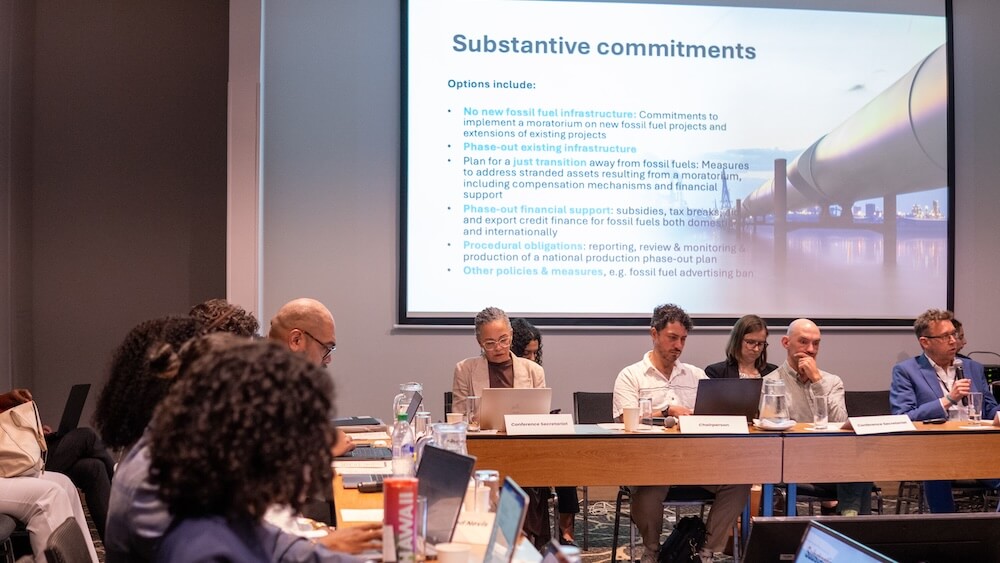
The two-day segment of ministers and senior officials marked the political centerpiece of the first conference focused on transitioning away from fossil fuels in Santa Marta.
Held in late April, the inaugural International Conference on Transitioning Away from Fossil Fuels (TAFF) couldn’t have been better timed to underscore the urgency of its stated goal. Following the war on Iran, the blocking of the Strait of Hormuz — the world’s most critical energy chokepoint for the transport of oil and petroleum — was wreaking havoc around the world.

Alex Rafalowicz
It turned out to be “interesting timing,” said Alex Rafalowicz, executive director of the nonprofit Fossil Fuel Treaty Initiative (FFTI), which hosted the conference in Santa Marta, Colombia, along with the governments of Colombia and the Netherlands. The geopolitical crisis highlighted how the reliance on a fossil fuel–based energy system exposes both importers and exporters to real security risks, he said. And it put the conference in sharp relief — contrasting the “imperial powers that will want to use military force to dictate terms in the world” against the values that align with the collection of 57 countries participating in the event, who seek to build a rules-based system based on cooperation, Rafalowicz said. “I think it did really raise the salience,” he said, “of why these conversations were so important.”
Coming Together
As perfectly timed as it seemed, you could say the conference was six years in the making. FFTI launched at the end of 2020 as “an alliance between governments and non-government actors who are trying to accelerate a proposal to help coordinate and cooperate on the transition away from fossil fuels internationally,” Rafalowicz told Convene. Its focus is specifically on the extraction and production of oil, gas, and coal — the single biggest driver of climate change.
There are currently 18 governments actively discussing the proposal, with 10 to 12 others who are “observers to that process,” he said. In addition, a network of non-government actors — thousands of NGOs, not-for-profit organizations, Indigenous nations and peoples, trade unions, banks, private sector groups, faith institutions, academics — and cities and almost 200 subnational governments have endorsed the proposal. Supported primarily by philanthropic institutions, FFTI “exists to try to bring this energy, momentum, and creativity together to try and imagine a new agreement.” While “treaty” is in the organization’s name, one doesn’t currently exist, Rafalowicz said. “It exists as an idea and a proposal. Our work is to try and turn it into reality.”
When FFTI was formed, “a lot of our effort was to try to get the UN Climate Change Summit to talk about fossil fuels,” Rafalowicz said. One of the primary reasons it didn’t want to, he said, is that COP “operates on a consensus process. Any one country can try to block the introduction of new ideas. You couldn’t even get fossil fuels on the agenda. The United States, Russia, Saudi Arabia — none of them want that on the agenda. It’s really, really hard to get it there, no matter how many countries actively push for it.”
 Subscribe to Convene.
Want deep-dive insights on events delivered to your inbox? Sign up for our newsletters
At the end of 2024, he said, those government ministers who were discussing a fossil fuel treaty met and proposed the idea of “a dedicated international process just on fossil fuels that we take out of the UN Climate Summit.” In other words, a conference that wouldn’t replace COP, which addresses other important elements of climate change, he said, but meant to “go a bit further and faster” toward what it sidesteps — practical ways to phase out coal, oil, and gas.
Some 3,000 people traveled to Santa Marta from April 24-29 for TAFF as the umbrella for other events, including an academic summit, Rafalowicz said. Conversations over those five days took different forms. “You saw a whole spectrum of ways of doing things,” he said. “There were storytelling rooms, there were panels, there were debate dialogues. Then, in the high-level segment, there was a plenary session, and then there were breakouts” with questions prompted by a lead facilitator in small groups of around 20 participants — a mix of government ministers, technical officials, Indigenous leaders, professors, and trade unionists. “They were just sitting in a circle,” he said, “responding to the question and listening to each other.”
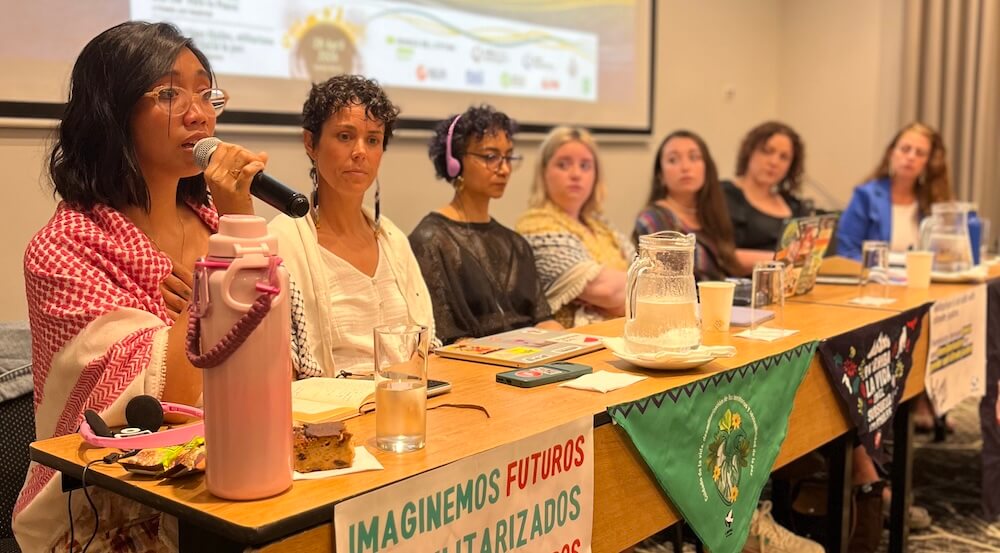
“Fossil Fuels, Militarism, and the Path to Peace: A Feminist Just Transition” panelists explored what it means to be safe in a warming world.
Next Steps
During the event, Tuvalu, a remote Polynesian island nation in the Pacific Ocean, halfway between Hawaii and Australia, made a commitment to host the follow-up conference next year, with Ireland as a co-host. Between now and then, working groups will continue the process TAFF started, Rafalowicz said. “We are optimistic that this will lead to more discussion about what a fossil fuel treaty could look like.” Another outcome he cited: the launch of a new international science panel on the energy transition, developed during the academic pre-conference.
When he was asked what success looked like prior to the conference, Rafalowicz said he saw it as an achievement that so many people were already talking about a phaseout of fossil fuels. “Then to have such a high level of turnout across different types of sectors, across the world,” he said, “and to really talk about issues in depth, it really changed the conversation and changed the game.”
Taking Ideas Forward
One standout feature of the first International Conference on Transitioning Away from Fossil Fuels, according to Fossil Fuel Treaty Initiative’s Alex Rafalowicz, was how the organizers, particularly the Colombian government, “really made an effort to engage stakeholders in the call for submissions. I think there were over 2,000 submissions, and they actually used those to make the agenda. It was quite innovative. Instead of the governments being like, ‘This is our agenda,’ they took what people said, and then [said], ‘Okay, these are then some of the questions and the issues that we want to talk about.’“
How does a conference on phasing out fossil fuels contend with its own environmental footprint? “We certainly continue to support the idea that not all of the discussions and all of the conversations need to be in-person,” Rafalowicz said. “Really structured and good virtual dialogues” were a part of the event in Colombia and that approach will continue in Tuvalu, he said.
“You want to be able to say, ‘You personally may not be in Tuvalu because we don’t want tens of thousands of people going there, but you can see that your idea was listened to, and there’s a person who has some responsibility or connection to you to keep taking that idea forward.’“
Michelle Russell is Convene‘s former editor in chief.