Log In


About the PCMA Global Student Competition
The PCMA Global Student Competition invites student teams from around the world to solve real-world challenges in the business events industry. Each year, participants develop creative, strategic proposals in response to a timely case study, then pitch their ideas to a panel of industry leaders. It’s a one-of-a-kind opportunity to showcase your talent, build your network, and make your mark on the future of events.
For questions or more information, please contact [email protected].
2025 Competition Winners & Finalists
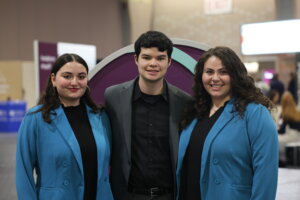
Photo by Jacob Slaton / Whatever Media Group
Johnson & Wales University was selected as the winner of this year’s Global Student Competition for their thoughtful, well-executed concept and strong understanding of how design, experience, and strategy come together in a live event environment. Team members included Natalie Silverman, Leif Knudson, Savannah Seda, and Faculty Advisor Katie Davin. Read their proposal.
Finalist Teams Included:
- Universidad de Guadalajara (View Proposal)
- Singapore Polytechnic (View Proposal)
- DuocUC – Team 1 (View Proposal)
- DuocUC – Team 2 (View Proposal)
2025 Competition Brief
Theme: Designing the District
The Future of Experiential Brand Engagement
This year’s challenge is to reimagine “The District,” the central brand activation area within PCMA Convening Leaders – a global event that draws over 5,000 business events professionals each January. The District is not your average exhibit hall. Instead, it’s a dynamic environment where partners and participants engage in meaningful, memorable experiences.
Your challenge is to conceptualize and design an engaging, experiential environment that delivers on the core goals of a trade show floor—while pushing boundaries of creativity, design, technology, and connection.
Keep in mind the main experience pillars of Convening Leaders: Content, Community, and Commerce in your design.
Your solution should help The District achieve the following goals:
- For Partners:
- Drive brand awareness
- Generate leads and new business opportunities
- Facilitate high-quality conversations
- For Participants:
- Discover innovative products, services and destinations
- Gain education through unexpected formats
- Make new business connections and develop relationships organically
Suggested Submission Elements:
To guide your proposal, consider including the following components (these are suggested, not required):
- Concept description and goals
- Visual mock-ups or renderings
- Sample sponsor activation ideas
- Traffic flow or floor plan considerations
- Technology and attendee engagement strategies
- Metrics for success
Proposal Design Principles:
A strong proposal will reflect the following qualities:
- Immersive: Go beyond booths – think sensory, emotional, and interactive experiences
- Purposeful: Every element should connect back to measurable goals.
- Sustainable & Scalable: Incorporate inclusive design and budget-friendly execution
- Future-Focused: Demostrate how The District can evolve alongside industry needs.
Submission Details & Requirements
To help guide your proposal development, we’ve provided a suggested structure below. These sections and page lengths are flexible—teams are encouraged to adapt as needed.
- Executive Summary (1 page)
- A high-level overview of your event concept and goals.
- Introduction (2 pages)
- Context for your project, including relevance and key considerations.
- Event Concept (3 pages)
- Outline of the proposed event, including revenue model and core elements.
- Landscape Analysis (Up to 5 pages; may be placed in appendices)
- Research on current trends, competitive events, and industry context.
- Detailed Program (4 pages)
- Schedule and description of event activities, with rationale for selections.
- Event Project Plan (10 pages)
- Venue or destination plan, space design, logistics, and innovation element.
- Marketing Plan (3 pages)
- Target audience, messaging, and channels used for promotion.
- Staffing Plan (2 pages)
- Management of staff, volunteers, partners, and sponsors throughout the event lifecycle.
- Financial Plan (2 pages)
- Budget overview, P&L, revenue projections, and cost analysis.
- References & Appendices (10 pages)
- Supporting sources and materials, including interviews, AI tools, or other research.
Teams are strongly encouraged to propose new and innovative ideas for these components. Proposed ideas need not be new for the industry, however, have to be an improvised version of the existing.
Please follow the formatting guidelines below when preparing your submission.
- Maximum 25 pages (not counting references or appendices)
- Submit as a PDF
- Use a readable 10–12pt font
- Pitches should be recorded via Zoom or Teams with supporting slides
- APA formatting for references
- Your proposal should look professional — clear layout, visuals where helpful, and consistent formatting throughout
Proposal Evaluation
- Concept & Problem Framing: Is the idea clear and well-reasoned? Does the proposal show a real understanding of the challenge before jumping to solutions?
- Audience Understanding: Does the team demonstrate genuine insight into what different generations of professionals want from events? Proposals that rely on broad generalizations rather than specific, researched perspectives will score lower here.
- Program & Experience Design: Are the programming choices thoughtful and specific? Does the event structure actually support the goals — or does it just describe them? This is the most heavily weighted section.
- Feasibility: Could this event realistically happen? Are the logistics and scale grounded?
- Impact & Evaluation: Does the proposal make a convincing case that this event would matter — to attendees, to the industry, or both? Is success defined clearly?
Pitch Presentation & Q+A (In addition to the above)
- Clarity and confidence of delivery
-
Ability to answer questions and defend your thinking
Five finalist teams will be selected by the Competition Committee following an initial proposal review. These finalist teams will present their ideas to a panel of industry judges through a recorded pitch and live Q&A.
- Finalists must submit a 5 minute recorded pitch presentation with supporting slides (e.g., PowerPoint).
- Each team will also participate in a live Q+A session (10–15 minutes) with the judging panel via Microsoft Teams.
-
Finalist presentation dates will be announced in advance.
- All participants must be currently enrolled undergraduate or master’s students in meetings/events management, business, hospitality, tourism, or a related field
- Teams must have 3–5 members; students from different academic levels may be on the same team
- Each student may only participate on one team
- Teams must register and receive an official PCMA-issued team name before submitting
- At the time of submission, the team’s college or university must have an active PCMA student chapter, and all team members must be PCMA student members — both are free. Learn more here.
- Complimentary round-trip airfare (up to $500 USD per person), hotel, and registration for Convening Leaders 2027
- Opportunity to present your ideas live at the event
- Hands-on collaboration with the PCMA team to bring elements of your concept to life at a future PCMA event
- Exposure to 5,000+ global event professionals and industry leaders
Resources
General Resources:
- The District – Overview Doc
- Comprehensive Industry Glossary
- Competition Requirements + Eligibility
- Judging Criteria Details
- PPT Sample Template (for finalist teams only) – for structure only, design and layout should be unique
- PCMA’s AI Tool: Spark – integrating generative AI as a resource tool is encouraged and should be referenced when used
- PCMA Partners – these are the organizations that typically support the District, for reference
- Current Sponsorship Package for the District – this is how The District is currently being positioned by the PCMA business development team
Suggested Learning Resources:
- Guiding Principles in Experience Design – Six Truths for Innovative Event Strategies
An industry-defining research series that identifies evolving behaviors and motivators shaping the field of experience design, thanks to a partnership between PCMA and Marriott International. - Reinventing Your Signature Event: Lessons Learned from the Field
Unpacking the real-world case study of how organizations reimagined their signature events to meet the new needs of their audience. From identifying areas for improvement to developing a comprehensive redesign plan, we’ll examine the challenges, strategies and key steps taken to transform a signature event into a success story. - How to Operationalize Your Commitment to DEI with a Supplier Diversity Program
If you want to be a DEI champion for your events there’s more to it than who is in the audience and on stage. Partnering with suppliers who are from different backgrounds, identities, and experiences is a critical part of living your expressed commitment and achieving better economic outcomes within the communities where you hold events. DEI Expert, Zoe Moore, provides a comprehensive overview of the strategies you must put in place, ideally at the RFP stage, to set goals, execute them and measure success. - Convene Article: ‘The Radical Act’ of Creating Community
- Convene Article: Building Events for Belonging
Past Winners & Proposals
2024: Singapore Polytechnic (Proposal)
2023: High Point University (Proposal)
2022: George Washington University & ISAE Universidad (Proposal)
2021: Durham College
2020: University of Florida
2019: California Polytechnic State University
2018: Kansas State University
Powered By