 Log In

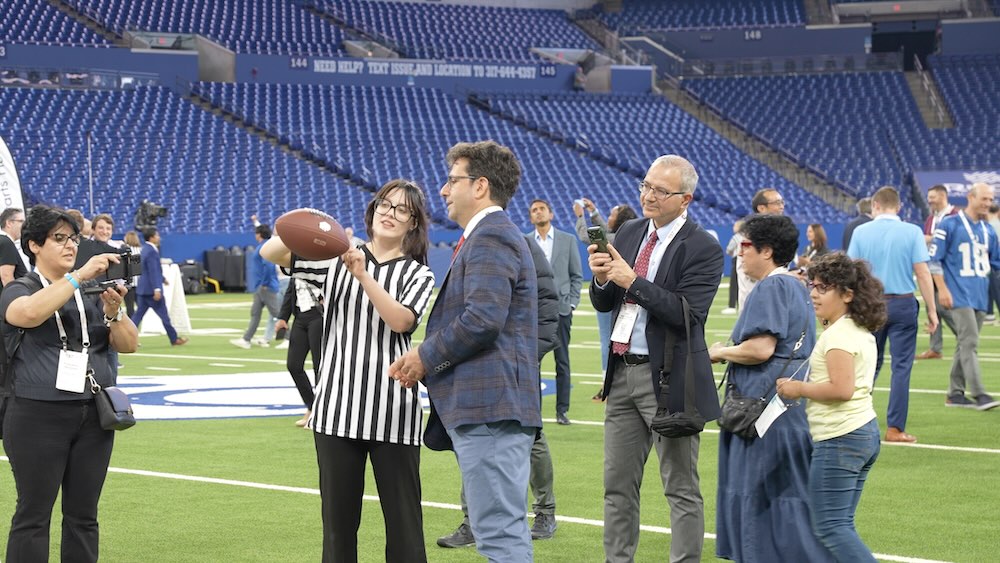
Surgeons took to the field at Lucas Oil Stadium during the AAO-HNS annual meeting
When Beth Burchill, CMP, joined the American Academy of Otolaryngology-Head and Neck Surgery (AAO-HNS) as the senior director of meetings, education, and corporate development in the summer of 2023, she noticed something about the organization’s Annual Meeting schedule: It didn’t give participants much breathing room. Breaks between education sessions were just 15 minutes long, stymying the opportunity for meaningful networking.
“If you’re too worried about trying to get to the bathroom, filling up your water bottle, and getting to the next session so you can get a good seat, you’re not going to take the extra seven minutes after a session to connect,” Burchill said. “If your schedule is off, your experience is off.”
The length of those breaks doubled to 30 minutes for its Annual Meeting in Miami in 2024. While it may seem like a small adjustment, it was a marked shift for an audience accustomed to packing as many lecture-style formats as possible into a three-day program. And it was a sign of even bigger changes to come.
At the 2025 Annual Meeting & OTO EXPO in Indianapolis, Oct. 11-14, at the Indiana Convention Center and JW Marriott Indianapolis Hotel, more than 5,400 health-care professionals experienced the organization’s willingness to evolve and experiment. In addition to sustaining those longer breaks, the latest meeting included new education formats modeled after popular programming like ESPN’s “Pardon the Interruption,” in which hosts discussed and debated the top issues in their field, and NPR’s “Wait, Wait, Don’t Tell Me,” where panelists were quizzed about topics relevant to their area of expertise.
In addition, AAO-HNS launched a new exhibit area focused on breakthrough technologies from startups and on-site child-care services to enable parents of young children to participate in the conference. Also making a debut: a new wellness zone, tucked away in the corner of the exhibit hall at the Indiana Convention Center, which became a hubbub of activity. Participants could schedule chair massages, join group breathing exercises, and find a quiet spot to decompress over a calming cup of tea.
Reshaping the Meeting With Perspectives From a Long-Time Attendee
One major influence behind all the program shifts: Cecilia Damask, D.O., FAOCOHNS, FAAOA. The comprehensive otolaryngologist has been coming to the meeting for more than two decades, and her experience inspired her to take on the four-year responsibility of annual meeting coordinator.
One area Damask wanted to focus on was making the event more experiential, reflecting post-pandemic realities. When it comes to learning, Damask pointed out that “the way physicians get their CME has changed after 2020.” There are now plenty of free online opportunities to get the credits to meet licensing requirements, Damask said, highlighting the importance of designing a program that can only be experienced live and in-person — and makes a lasting impression. The President’s Reception was one example: On the Friday evening before the opening general session, attendees got to be on the field at Lucas Oil Stadium, home of the Indianapolis Colts. “For a lot of people, that’s a once-in-a-lifetime moment,” Damask said. “You could only get it if you come to the meeting.”
At the same time, one of the busiest areas at the convention center demonstrated that some of the best activations don’t require the budget to rent an NFL stadium or the need to find a sponsor to help offset the expenses of three days of massages. The Talking Point — an area located outside the exhibit hall — invited attendees to write responses on Post-it notes to questions such as what inspired them to pursue a career in otolaryngology and what advice they would offer the younger versions of themselves.
Attendees also used pushpins on a world map to indicate where they practiced — a visual picture of the more than 75 countries that were represented at the meeting.
The analog activity served as “a reminder that not everything has to be digital,” Burchill said. “These are surgeons who work with their hands all the time, so let’s give them something to do with their hands. Putting that pin in to show where you work and where you went to school is something they love to do.”
 Subscribe to Convene.
Want deep-dive insights on events delivered to your inbox? Sign up for our newsletters.
A ‘Bit More Comfortable’ for All
Like many conferences, AAO-HNS attracts attendees who may still be in school — and others who might be in their 80s. “The generational divide is very real,” Damask said. “So, we take a lot of baby steps of trying new approaches.”
The makeup of the program — more than 500 sessions stretched throughout 28 breakout rooms that run simultaneously — gives Burchill the ability to balance the needs of long-time attendees with the expectations of an emerging generation of otolaryngologists. “If you’ve been coming forever and you love to sit and listen to an hour-long panel, we have plenty of that,” Burchill said, “but we can take two rooms and test out something new. It’s all about allowing for some innovation while keeping and honoring the tradition.”
Damask, whose program role continues through 2028, said the 2026 Annual Meeting in Los Angeles, Oct. 17-20, will trial other tweaks, like 30-minute sessions, which she called “groundbreaking.” It will be interesting to see whether faculty are interested in presenting shorter sessions and how well they are attended, she added.
All these changes reflect an aim to continue refining the experience into something that energizes without overloading attendees — “every annual meeting is going to be a grind,” Burchill said. “But we want to make it just a little bit more comfortable where you’re not having to get up quite so early or where you’ve got a little bit more time to take care of your needs in-between sessions. We want to make it so that when you go home, you’re feeling rejuvenated and enthusiastic.”
‘Not the Way Adults Learn’
In otolaryngologist Cecilia Damask’s role as AAO-HNS Annual Meeting coordinator, one of her goals has been to diversify the speaker lineup. When she attended as a resident, she noticed “there were not a lot of women speakers and not a lot of other speakers from underrepresented communities,” she said. “It was always the same historic people lecturing. It just felt kind of like the status quo.”
But Damask also has wanted to do more than change the old guard — namely, to encourage speakers to make a bigger impact by doing less presenting and being more engaging. For example, at the 2025 conference, some sessions gave the audience the ability to vote up or down on potential solutions, while others were gamified with points to create more energy among participants.
Some of those ideas came from the first chapter of Damask’s career. Prior to becoming an ENT doctor, Damask taught high-school science, chemistry, and algebra in Chicago. She said that her passion for teaching and the lessons she learned from those students have informed the way she thinks about adult education. “If you don’t keep those students engaged during your lectures for the 30 or 40 minutes that you have them,” she said, “they don’t learn and they don’t retain anything.”
Some lectures at past editions of the Annual Meeting had stretched as long as two hours — great for packing in information, but not great for extracting much value from it, Damask said. “That’s just not the way adults learn.”
David McMillin is a former Convene editor and freelance writer.
Learn more about the 2026 AAO-HNSF Annual Meeting & OTO EXPO.