 Log In

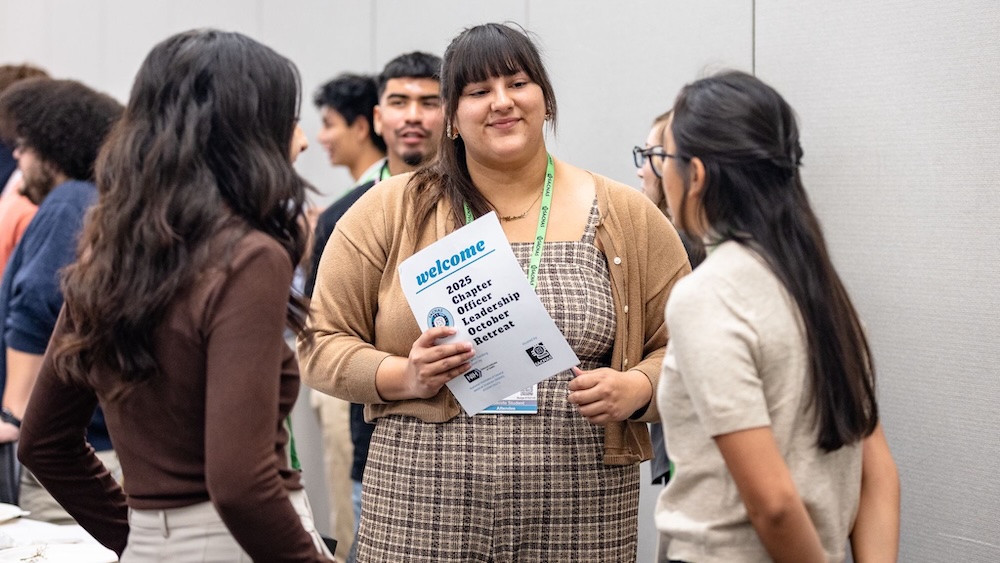
Attendees network at the NDiSTEM 2025 conference in Columbus, Ohio
Last fall, the United States government shut down for nearly six weeks (Oct. 1 through Nov. 12) because Congress was unable to come to agreement on 2026 appropriations legislation. This stalemate resulted in the furlough of some 900,000 federal employees and the need for another 700,000 or so to work without pay, according to the nonpartisan Partnership for Public Service. This budgetary gridlock threw yet another wrench into the events industry, specifically for U.S.-based meetings and events scheduled during the shutdown period. As the political impasse dragged on, one event turned its budget upside-down to help attendees get to the meeting. Other STEM events have been navigating other challenges outside of the shutdown due to the current U.S. administration’s policies over the past year. One event created a workaround for visa headaches — and an enterprising science educator created an innovative program to give students — who were otherwise financially unable to attend due to federal budget cuts — the means to fully experience a STEM conference. Here are their stories.
Strategic Triangulation
The scientific journal Nature reached out to associations last fall for a pulse check on attendance or anticipated attendance at meetings scheduled in the second half of 2025 and first half of 2026, as reported in the article, “Scientists skip key US meetings — and seize on smaller alternatives.” The story highlighted how NeurIPS, a major AI conference hosted in San Diego in November 2025, added its first-ever alternative location to accommodate anyone who was unable — or unwilling — to travel to the U.S.
The NeurIPS conference is organized by the nonprofit Neural Information Processing Systems Foundation, and the decision to host a multisite meeting was made in light of challenges attendees could face in traveling to the U.S., as announced on NeurIPS’s website last July: “For the first time, in 2025, NeurIPS will host a second official physical location for the conference. The conference will be held at the San Diego Convention Center and in Mexico City. This pilot program of a second official location will allow us to continue supporting exchange and communication across the field of AI research while responding to skyrocketing attendance and difficulties in obtaining travel visas some attendees have experienced in the past few years when only one location was available.”
NeurIPS 2025 had a bicameral organizational structure with two general chairs dedicated to the U.S. meeting and one for Mexico and posted parallel schedules for the San Diego and Mexico City events on its website. Giving attendees the option to travel to Mexico City instead of the U.S. alleviated the headache of obtaining a visa and clearing customs in the U.S., not to mention the as-then-unknown impact of furloughs and layoffs on air travel to and within the U.S. in November 2025, when the meeting actually took place.
At the same time that NeurIPS was held in both locations, a group of European AI researchers hosted EurIPS, an independent spin-off conference, in Copenhagen. “Our main focus was on giving a home to people who felt intellectually homeless this year,” Søren Hauberg, a researcher at the Technical University of Denmark in Lyngby and EurIPS organizer, told Nature.
 Subscribe to Convene.
Want deep-dive insights on events delivered to your inbox? Sign up for our newsletters
Finding the Funding
Last Oct. 13-15, the Association of the United States Army (AUSA) held its annual convention, the Association of the United States Army Annual Meeting and Exposition at Washington, D.C.’s Walter E. Washington Convention Center. The unfortunate timing of the event meant that many attendees and potential attendees would not be receiving their regular paychecks. Veterans’ benefits and military operations were also defunded during the shutdown, creating additional barriers.
On Oct. 1, the day the shutdown began, AUSA issued a press release: “If the government shutdown continues, the Annual Meeting will proceed as planned, and AUSA will continue telling the Army story and bringing together key stakeholders and partners who are invested in the Army and its transformation for the future. As an educational nonprofit dedicated to supporting and advocating for America’s Army and a strong national defense, we are focused on our mission to support the Army.”
In order to ensure that enlisted service members would have the budget to attend the 2025 meeting, AUSA’s board of directors got a little creative. The AUSA provided a donation of over $1 million to cover the travel, lodging, and food expenses for active-duty soldiers and senior leaders to attend the conference. “The Army is focused on taking care of the mission, even with everything that is going on,” Retired Lieutenant General Leslie Smith, vice president for leadership and education for AUSA, told WUSA9 News. “It’s important we have the time to educate, inform, and connect. That’s what AUSA is all about.” The meeting proceeded as planned, with military leaders, industry professionals, policymakers, service members, and international delegates on hand to celebrate the Army’s 250th birthday.
Teaching the Value of Conferences
To counteract the effect of federal cuts in funding for institutions of higher learning on students’ conference attendance, last fall New Jersey’s Rutgers University–Camden launched a new three-credit experiential learning course that uses tuition revenue to cover students’ registration fees and travel costs to participate in a STEM conference. The undergraduate course has been designed to help students understand firsthand how they can benefit from attending scientific conferences.
Kwangwon Lee, a professor of biology, created the curriculum to introduce students to conference expectations, presentation skills, and proposal preparation. The course was open to all STEM undergraduate students who were currently conducting research under the supervision of a faculty mentor. “For many years, I was able to take undergraduate researchers to national conferences with federal grants, but that funding was cut unexpectedly earlier this year,” Lee told Rutgers University–Camden’s news service. “Knowing how transformative these experiences are for our students, I wanted to keep the opportunity accessible, especially for students who would not otherwise be able to afford it.”
The first cohort of 10 students traveled to NDiSTEM, a multidisciplinary and multicultural annual STEM conference that was held in Columbus, Ohio, last October. “Students had the chance to meet peers from diverse backgrounds, hear from outstanding scientists, see the breadth of work happening across STEM fields, and learn about a wide range of STEM career paths available to them,” Lee said.
One of the biology students, junior Tiffany Chan, told the university news service that removing the financial constraints enabled her to focus on preparing her research for submission to the conference. “This is just the kind of experience that you can never get from just the classroom alone,” said Myo Thinzar Htin Aung, a senior in the class. “As a first-generation student with limited opportunities, I felt this course was like an open door to something I had always hoped to experience but never imagined I could access so early in my academic journey.”
Kate Mulcrone is Convene’s digital managing editor
- Read Nature’s coverage of how the shutdown affected U.S.-based scientific meetings and learn more about NeurIPS.
- Learn more about how the AUSA helped enlisted service members attend the U.S. Army’s annual meeting and find out more about the event itself.
- Read about how Rutgers–Camden students had the chance to learn and practice conference skills and attend a STEM meeting and see more about the NDiSTEM meeting.