 Log In

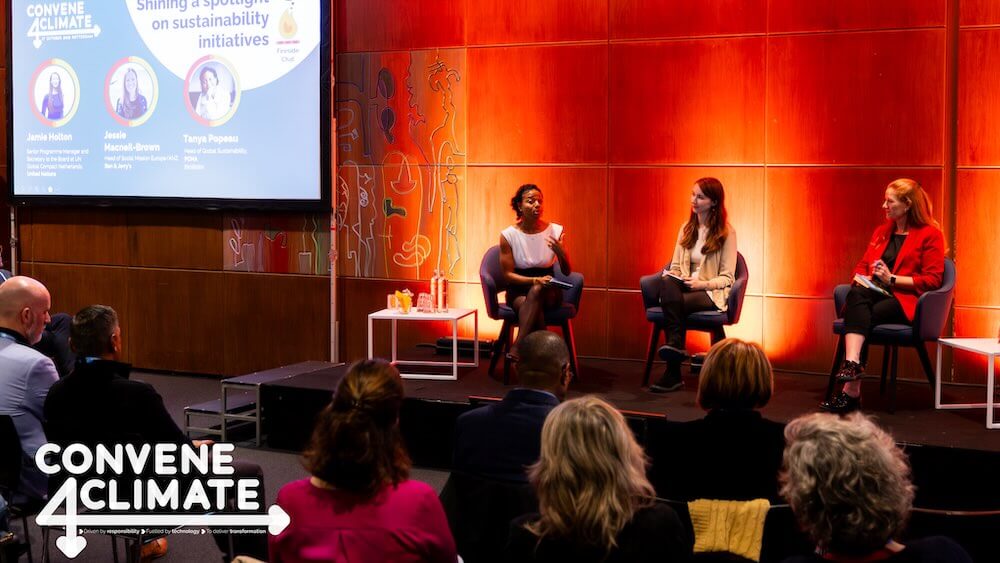
From left, Tanya Popeau, PCMA’s global head of sustainability; Jessie Macneil-Brown, head of social mission for Ben & Jerry’s in Europe, and Jamie Holten, senior program manager for the UN Global Compact, the Netherlands
Behavioral expert Thimon de Jong, a keynote speaker at PCMA Convening EMEA in Rotterdam in October, uses the term “polycrisis” to describe our present moment — a time when disruptions such as political polarization, rising mental-health challenges, and the accelerating effects of climate change overlap and intensify one another. In a world where our challenges are increasingly interconnected, their solutions must be interconnected as well.
Sherrif Karamat, CAE, President CEO, PCMA and CEMA
Social infrastructure — the trust and interpersonal relationships that make cooperation possible — is one of the strongest predictors of a community’s resilience in times of crisis, research by sociologist Eric Klinenberg, director of NYU’s Institute for Public Knowledge, has shown. Economists use a related term, “soft infrastructure,” to describe the human networks that build trust, circulate information, and make coordinated action possible — and are key drivers of economic growth.
All of this means that the role business events play in creating and sustaining knowledge-sharing networks across industries, geographic regions, and multiple generations has never been more important. I saw this firsthand at PCMA’s second Convene4Climate (C4C) conference in Rotterdam, where experts from fashion, finance, development, and other fields joined business event leaders to examine the strategies that have made their organizations both more successful and more sustainable.
C4C was far more than an exchange of information — participants met in working groups to map out ways sustainability can lead to business opportunities, creating relationships between ideas and people that will extend into the future. As one participant said: “The consensus is that we can’t work alone.”
The physical infrastructure for meetings also matters — not just for logistics, but for the kind of environments they create. Venues are being redesigned to encourage deeper connection, helping participants engage not only with ideas that come from main stages but with one another. Destination organizations have become skilled at using events to immerse participants in local culture and showcasing local expertise and innovation.
It matters, too, that we meet in person. Research across public health, psychology, and behavioral science continues to show that face-to-face connection reduces polarization, strengthens trust, and supports both physical and mental well-being.
As thousands of us prepare to gather at Convening Leaders 2026 in Philadelphia in January, I am further encouraged by the many ways our global community strengthens and maintains social infrastructures across myriad contexts, cultures, and places. The ability to come together is what allows societies to adapt and thrive — rather than fracture — in response to challenges. That’s the work of our industry at its best.
A Business Events Flex
One takeaway from this year’s Meetings Market Survey is that the global business events industry is demonstrating flexibility in the face of challenges: Three-quarters of respondents said their organization’s business model has changed — compared to last year when only one-quarter said the same.