 Log In

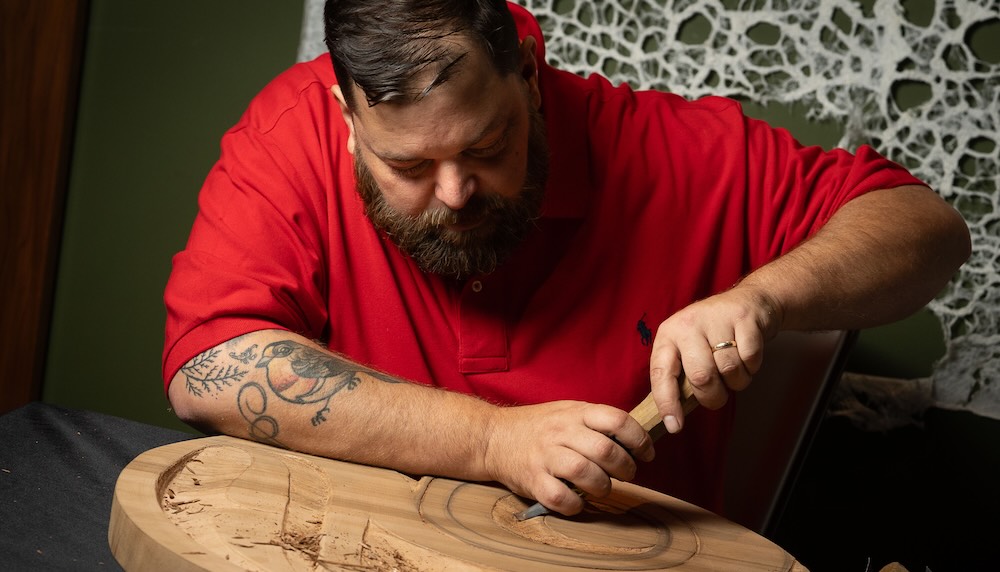
First Nations painter and carver Adam Lewis.
Colette Lynch, a director for the Western region of the conference- and destination-management company JPdL, is based in Vancouver, British Columbia, a province that’s home to more than 200 First Nations Indigenous communities. It’s common, Lynch said, for her to field requests from meeting clients who say, “We hear it’s really important to acknowledge the First Nations — can you book us a land acknowledgement?” Often, Lynch said, that means “maybe an elder comes in for five minutes, says a blessing, and that’s it.” It’s authentic, but she is always looking for ways to recognize the ongoing relationship of the First Nations with the land, so that the exchanges “become more of a conversation,” she said, “than just a moment in an overall experience.”
That opportunity came when the International Academy of Trial Lawyers (IATL), a 70-year-old organization founded to protect and promote the rule of law, held a four-day meeting in Vancouver in August. During their initial site inspection in Vancouver two years ago, Joe Tucker, the academy’s 2025 president, had made it clear it was important for the organization to recognize the First Nations in meaningful ways. “I want to pull this through our entire program,“ he told Lynch. “Do you have any ideas?”
One of the most important ways First Nations communities pass down stories and cultural knowledge is through art, Lynch said, and she had been turning over ideas in her mind about how to include wood carving, a primary Indigenous art form in the forested Northwest Coast, at events. She hadn’t yet found a way to include carving along the fast-moving timelines that events and fam tours typically follow, she said, but the IATL meeting offered days, not hours. And Tucker, Lynch said, “seemed really open to ideas that no one has done before.”
Lynch proposed that IATL hire a local Indigenous artist who would create a carving on site over the course of the meeting — a kind of artist-in-residence — and then the work would be auctioned off at the event’s closing gala. The proceeds would go to the IATL Foundation, which funds grants for programs that aim to reduce homelessness and human trafficking, among other social issues. Tucker loved the idea — and then Lynch had to find a carver.
The combined cost of the artwork and the time that an artist would spend on site meant that many established Indigenous carvers would be out of reach, especially if the IATL Foundation hoped to net enough money to help fund its initiatives. Lynch was combing through Indigenous artists’ accounts on Instagram when she discovered a profile that turned out to be a perfect fit: Adam Lewis, a We Wai Kai artist from Cape Mudge, B.C., an emerging painter who combines a contemporary color palette with traditional art forms — and had also recently begun to carve wood.
 Subscribe to Convene.
Want deep-dive insights on events delivered to your inbox? Sign up for our newsletters.
‘He Was Never Really Alone’
The meeting’s 250 participants met Lewis at an evening welcome reception, held in a prefunction space at the Fairmont Pacific Rim, where the artist sat at a table with his carving tools and a blank slate, in the form of a round piece of cedar sourced from Lewis’s traditional territory on northern Vancouver Island. Once the program got underway, Lewis was back at the table for hours every day, carving a salmon egg image, which holds both personal and cultural meaning for the artist. Lewis “was never really alone” while he was at the table, said Maik Uhlmann, a JPdL program manager who worked with Lynch on the project. “People were so interested in what he was doing, why he was there, and what inspired him.”
In all honesty, Lewis told Convene, he hadn’t been exactly sure what to expect at a convention of lawyers. But he would learn that the academy’s membership — which is limited to 500 American trial lawyers and 50 international fellows and advocates for equal justice for all and high standards of integrity and civility in the legal profession — has “an extremely thick moral fiber,” he said. “It was such a warm feeling to be there and carving with them.”
Lewis was joined at the meeting by his wife Robin, who kept the conversation going when he was “nose down, carving and creating,” the artist said. The meeting participants were “so kind and sharing with their lives and asking us questions about ours,” she said, and she ended up attending some of the sessions with IATL members. “It was special for both of us to see just how far the reach of respect and understanding could go.”
The fact that the final artwork would be auctioned hadn’t been officially announced, but there was a steady buzz of speculation at his table throughout the week, the artist said.
On the event’s last day, Lewis took the carving to his hotel room to stain it with beeswax as a finishing touch. Then, after the event’s closing gala dinner, a professional auctioneer joined Lewis on stage, and the completed artwork was unveiled. Lewis spoke for a few minutes about how he became a carver and where the inspiration for the piece came from.
The bidding was lively — and carried an emotional charge, because of the relationships that developed during days of interaction between the artist and meeting participants, Uhlmann said. When the auctioneer put the gavel down, the winning bid was $15,000. “I was nervous and excited,” Lewis said, “because I really wanted it to turn out well for the foundation. I knew that the money being raised was going to such a good cause.”

Adam Lewis’s first artistic medium was aerosol paint, which he used for sign and mural painting.
Salmon People
First Nations artist Adam Lewis grew up in a creative family in the We Wai Kai Nation reserve in Cape Mudge, B.C., and his first medium was aerosol paint, which he used for sign and mural painting, he said. Before he began working in the Pacific Northwest Coast traditional “form line” style, characterized by flowing lines, he first had to study its protocols, he said. The style has traditionally been used to depict stories, family crests, and spiritual ideas, and “there is a very proper way to do it,” Lewis said. He also sought the advice of other Indigenous artists, many of whom were carvers, and who inspired him to begin working with wood.
He chose to carve a salmon egg image for the IATL, because “the Northwest Coast people are the Salmon People,” he said. What the salmon egg “means in our culture is sustenance and growth, and it also means prosperity and the continuation of family.” Wild salmon has been a staple sustenance for Indigenous people for millennia, Lewis wrote about another of his salmon egg carvings. “This deep, historical relationship between us and the salmon speaks to a way of life built on respect for the land, sustainable living, and the rhythms of nature.”
Barbara Palmer is Convene’s deputy editor.
On the Web
- Find out more about the International Academy of Trial Lawyers at iatl.net.
- Adam Lewis’ art can be found at AdamLewisArt.com.