 Log In


There’s an element of anxiety that comes with feeling frozen and feeling like you’re not sure what the right path to choose is,” Ben Johnston said in a recent Investopedia article. Investopedia gave it a name: “business paralysis,” which sets in when organizations try to move forward during a period of rapid or unclear changes — in-flux tariff policies during 2025, for example.
Johnston is COO of Kapitus, a provider of small business loans, and the article focused on how, for small business owners, uncertainty is a greater challenge than definitive bad news. A 2025 report by the National Small Business Association cited in the story found that economic uncertainty outranked other challenges their members (numbering 65,000-plus) were experiencing, including inflation, tariffs on foreign goods, supply-chain delays and disruptions, lack of qualified workers, and regulatory burdens.
A mid-year PwC pulse survey checked in with the larger U.S. business world — executives across industries, who are fielding additional recent changes. These include U.S. economic, trade, budget, immigration, tax, and climate policies, as well as government spending. PwC’s survey found that companies were taking both short- and long-term steps to mitigate the negative impact of these uncertainties on their business. One near-term strategy for some consumer packaged goods (CPG) companies: stockpiling materials before costs rise and engaging in tougher negotiations with suppliers. Long-term solutions included rethinking talent models, embedding AI to improve efficiency, and doubling down on brand differentiation to turn disruption into advantage.
 Subscribe to Convene.
Want deep-dive insights on events delivered to your inbox? Sign up for our newsletters.
Where the Events Industry Stands
Unlike the way small business owners react to operating in a cloud of uncertainty (as characterized by Investopedia), business event organizers can’t afford to give in to a feeling of paralysis. The show must go on. Planner respondents to our annual Meetings Market Survey also mentioned political and economic fluctuations as stressors, particularly in how federal funding cuts have had a negative effect on attendance, but they said that bigger challenges were shrinking resources and rising costs, especially for F&B and AV. And unlike how CPG companies were stockpiling materials to save on rising costs, planners can’t purchase these items and services used at face-to-face events and store them for a later date. Nor are all expenses negotiable — suppliers pass along their own rising costs of doing business.
One big takeaway from this year’s Meetings Market Survey results reflects the opposite of paralysis: It’s how the business events industry is demonstrating flexibility. Three-quarters of respondents said their organization’s business model has changed, compared to last year when only one-quarter said the same. In this way, they are engaging in similar long-term strategies to move forward during a period of economic and political upheaval as the corporate execs surveyed by PwC.
Planners said they are leaning into data and ROI-driven decision-making, trying out new pricing or revenue models, reworking events to be more localized or segmented, and reorganizing internally to meet current and potential future challenges head on. And in terms of brand differentiation, more than a quarter of respondents said they have invested in sustainability and DEI programs — despite the backlash to both in the current U.S. administration. It would seem that organizers recognize that setting high standards in sustainability, accessibility, and belonging distinguishes their events and signals their commitment to the planet and people.
Since 2025 has been a bumpy ride, it’s not surprising that nearly one-third of respondents to this year’s Meetings Market Survey — compared to 11 percent in 2024 — said they are more worried than excited about the future. Nearly one-half said they are split — both excited and anxious about the future. This planner respondent explained how it’s possible to straddle the two emotions: “There is so much opportunity ahead but there is also uncertainty. I think the need for in-person [events] will always remain (especially if more of our lives are moving online), so I feel confident in job security. It’s just being able to do that sustainably and with the resources I am given that I am concerned about.”
Michelle Russell is Convene‘s Editor in Chief.
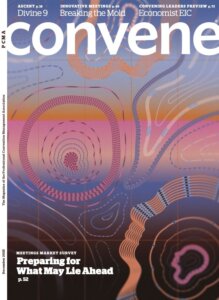 This article and those listed below are part of Convene’s December 2025 issue. Find the turn-page versions of this and past issues at in our digital library. Illustrations by Petra Péterffy
Earn CMP Credit
Earn one clock hour of certification by visiting pcma.org/convene-cmp-series to answer questions about the articles in this cover story package.
The Certified Meeting Professional (CMP) is a registered trademark of the Events Industry Council.

Convene’s 32nd Meetings Market Survey Results
Responses from Convene’s Annual Meetings Market Survey show the varying ways that event strategists are managing uncertainty, maximizing attendee engagement, and adopting new technologies like AI. READ MORE

What’s Ahead for the Events Industry in 2026?
Convene asked planners: Are you more worried or more excited about the future? The answers we got sparked a deeper conversation about how the industry sees itself in the current moment. READ MORE

Planners Share Their Recent Challenges and Rewards
Meeting planners from around the world shared how they’re staying flexible at a pivotal moment for the business events industry. READ MORE