 Log In

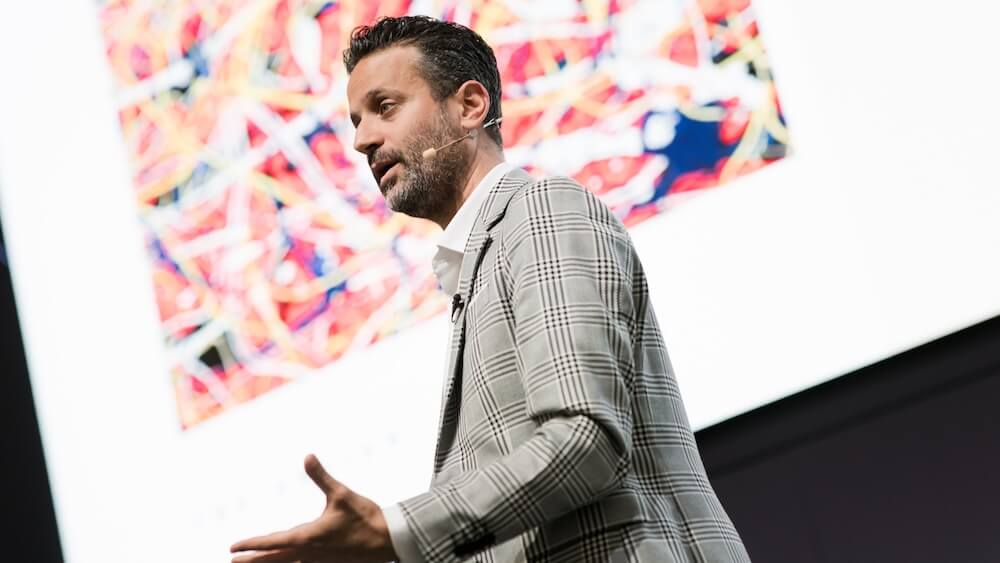
Business professor Nir Hindie, founder of The Artian, speaks frequently about the relationship of art to business, and business events.
As a kid growing up in Tel Aviv, Israel, Nir Hindie loved the creative worlds of art, photography, and architecture, and he also loved business and technology. Society seems to channel us into choosing one or the other, said Hindie, an entrepreneur, keynote speaker, and educator, and he chose business, earning degrees in economics and technology, and an MBA from IE Business School in Madrid, where he now teaches.
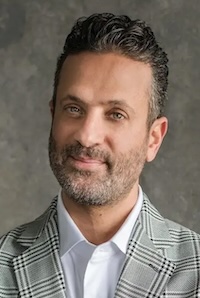
Nir Hindie
Hindie founded multiple companies and held business development- and investment-related roles at startups early in his career, but he never lost interest in the arts. Moreover, he kept noticing the many connections between artists and entrepreneurs. In grad school, for example, he’d observed that “classic MBA programs focus on analytical and hard skills,” Hindie said. “At the same time, we were all talking about innovation, entrepreneurship, and creating new things — areas that actually require a different set of capabilities, closer to what artists are trained to do.”
A decade ago, Hindie founded Artian, a creative leadership development studio, using the term “business artistry” to describe an artist-informed mindset that uses business as a medium for creating human value. As a business founder, Hindie already was accustomed to thinking of events as a platform for exchanging ideas and began to experiment with hosting pop-up art shows in labs and incubators for entrepreneurs. He also brought artists into start-up conferences, as a way of sparking participants’ curiosity and creating friction between ideas.
As he studied how art impacts business, one of the first things Hindie realized was that art is not an object. “Art is a way of thinking,” he said, “and the object is the end result of this thinking.” Hindie also discovered ways in which the artist’s mindset is a strategic asset in business, including in the example of Apple founder Steve Jobs, who approached every detail in the design of the company’s computers and its operating systems as if they were works of art. For Jobs, creating new technology wasn’t the endpoint, it was always about the human experience, Hindie said. “Engineers stop when they solve a problem, but artists don’t stop until it means something to someone.” And while business is “driven toward finding answers,” Hindie said, “art is much more driven toward questions. What you need in innovation is better questions.”
 Subscribe to Convene.
Want deep-dive insights on events delivered to your inbox? Sign up for our newsletters
Key to both the events world and artistic spaces is how they are rooted in experience, said Hindie, who presented a workshop, “Renaissance of Renaissance Thinking: Why Business Needs Artistry,” at PCMA Convening LATAM in Quito, Ecuador, in May. “When I look at artists, there is so much to learn.” Here are some of those lessons, in his words, distilled from conversations with Convene:
› Start with how you want participants to feel.
One of the first ways to begin thinking like an artist is to change your departure questions. Often the question that we start with is: “How do I make things more efficient, more seamless?” Artists will start with, “How do I want you to feel?” and work backward, asking themselves, “What do I need to do in order to achieve it?” At events, we are so focused on the logistics and the content and the food and the security — which are all important. But we don’t ask ourselves the simple question — when participants, when human beings, leave this place, what do we want them to feel?
› Understand the negative spaces.
When you learn how to draw, you learn how to see the world — drawing is an exercise in observation. If I tell you to draw a chair, for example, you have a mental model of what a chair should look like. So to try to break this mental model, you learn in drawing class: Don’t draw the chair, draw the spaces around the chair. When we say, “successful event,” immediately people have in their mind what a successful event looks like. But when we focus on the question of what an unsuccessful event is, we may actually see our blind spots.
› Don’t let constraints limit your ambition.
Artists are people who have less access to resources than most of the business world. And they are still able to build incredible experiences — which tells you that it’s not only about resources and the spectacle. You can bring in the best LED screen to impress [an audience], but the fact that I impressed you doesn’t mean that I impacted you. There is a difference between the spectacle and the meaningful. Artists are always working with fewer resources, fewer people, less money … but still they’re able to create experiences that leave us in awe.
› Experiment.
I don’t have any aspiration that only art can lead the business world — or that only business can lead the business world. It’s a mix and every one of us needs to find what works for them best. But ask yourself: If at every event where you have 10 steps, can you allocate one of those steps to trying something new? [Your events] don’t have to be 100-percent the same or 100-percent experimental. Maybe you can do things 95-percent the same and 5-percent experimentally. Is that a conversation worth having?
Barbara Palmer is Convene’s deputy editor
 Artful Experiences
This article and those listed below are part of Convene’s June 2026 issue cover and CMP Series story package.