 Log In

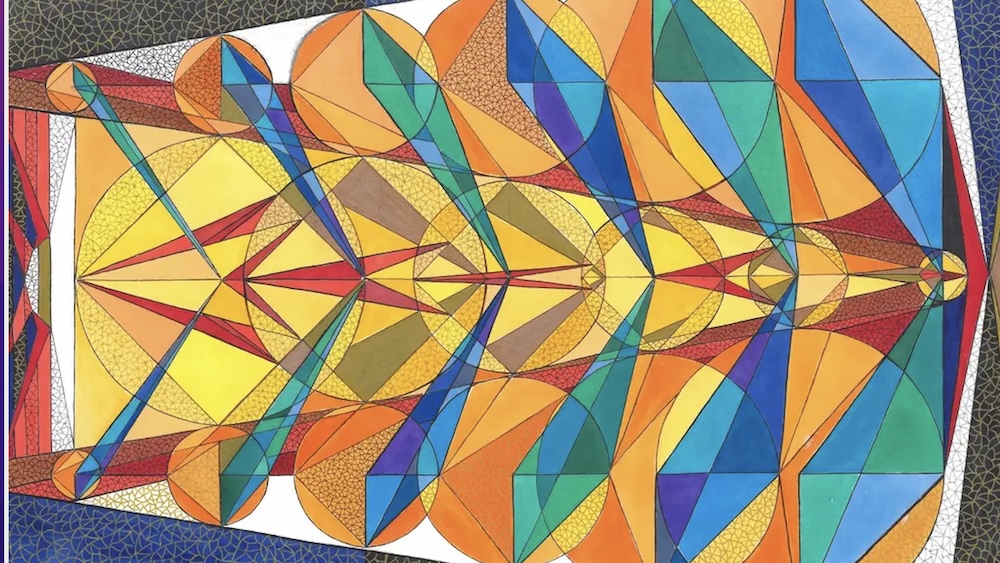
“Searchlight Rays” by Karen Amanda Harris was part of the 2025 Bridges exhibit.
Robert Fathauer brought the idea of adding an art exhibit to the organizers of the American Mathematical Society’s (AMS) Joint Mathematics Meetings (JMM) in 2004, when the conference was held in his hometown of Phoenix. Prior to that, Fathauer — who has a Ph.D. in electrical engineering, and has made his passion for mathematical art into a small business in addition to authoring several books on tessellations (patterns with geometric shapes or tiles) — had organized an art exhibit at the Bridges conference, a small gathering (around 400 participants) on connections between mathematics and the arts.
The exhibit started out occupying a small room, then grew to a 30′ x 50′ spot in the exhibit hall and is now held in its own large room, accommodating some 100 pieces of art. Fathauer remains one of the exhibit curators/organizers.
Anyone can submit art for consideration for the exhibit via a website, which is judged by a jury and those whose artwork is accepted ship their piece to the conference venue or, if attending the conference, drop it off in person.
“The majority of people who show at these exhibits are mathematicians or computer scientists professionally and artists as a hobby. There are some who are professional artists that use math in their work, too. It’s open to anyone,” Fathauer said.
A variety of mediums is accepted, from paintings to fiber arts and woodworking to ceramics. The only requirements: The piece can’t be too large to be displayed on a tabletop, require installation, or need to be hung from the ceiling.
Fathauer thinks the art exhibit serves as a welcome mental break for conference participants. “This is the big meeting for professional mathematicians. There’s like 20 or 30 parallel sessions, and most of them are [about] things like third-degree elite algebra, structures, and that kind of stuff,” he said. “It’s heavy math. Most of the exhibitors in the exhibit hall are either textbook publishers or software companies. There aren’t many that are more on the ‘fun’ side. I think the exhibit is something different, brings a little variety in their day. It looks at math in a different way, and celebrates the beauty of mathematics, showing it as art.
“I think most mathematicians, or at least the ones that would be interested in the art exhibit, appreciate the playful, recreational, and beautiful side of math, and so they enjoy [objects] that stretch things a little bit and reflect math in the real world or more playful aspects of math. They talk to each other. They may talk to an artist who’s around.”
 Subscribe to Convene.
Want deep-dive insights on events delivered to your inbox? Sign up for our newsletters
Chalonda James, director of communications and marketing for AMS, also said the art exhibit offers conference participants “another touchpoint to connect with fellow mathematicians.” The exhibit space is intentionally placed next to the poster sessions “so that when students aren’t presenting,” she said, “they can walk through the space and interact with the artists.” It’s a big draw among students, she said, who represent a significant portion of the approximately 5,500 attendees. “Some even come back the following year with their own art.”
The art exhibit’s location on the JMM show floor, James added, also benefits trade-show exhibitors by contributing to overall traffic, a strategy she thinks extends to all kinds of events with a show component. “Exhibit managers are always looking for engaging activities that draw more traffic to their show floor, and this would be a strong addition to any event,” she said. “That said, it’s important to have someone dedicated to managing the space and actively promoting its availability. With the right oversight, the return on investment would likely make it well worth the effort.”
For Fathauer himself, mathematical art “brings together a couple of interests. I’ve always liked mathematics, and I’ve always done art. I know a lot of people like that. They’re interested in both visual arts and math, and they like to bring them together. It’s like there’s a lot of math in music, and there are a lot of mathematicians who are quite good musicians,” he said. “People who see the world more holistically or think interesting things happen at the intersection of disciplines are drawn to that kind of thing.”
Bridging Math and Art
The Bridges conference “has been held annually since 1998, and we continue to grow and evolve as an organization and a conference,” Craig S. Kaplan, Ph.D., told Convene. “I first attended in 1999 and came away deeply inspired to pursue topics related to the ideas I saw at the conference — that first contact quickly became a central focus of my graduate studies and then my academic career.” Kaplan, a professor of computer science at the University of Waterloo, Canada, whose research work focuses on the application of computer graphics and mathematics in art and design, serves on the board for the Bridges Organization.
“The conference provides a forum for the publication of new scholarly research in what might be considered a niche area,” Kaplan said. “There aren’t a lot of venues where one can publish new research on mathematical art. But more than that, we hope to foster two-way interaction between scholars and artists, where we can inspire each other and seek out new collaborations. We host an exhibition of art, craft, and design at each year’s conference, as well as many live performance events — music, theatre, poetry, film, and fashion.”
Michelle Russell is editor in chief of Convene.