 Log In


Study results show a need for specialized AI training for event planners.
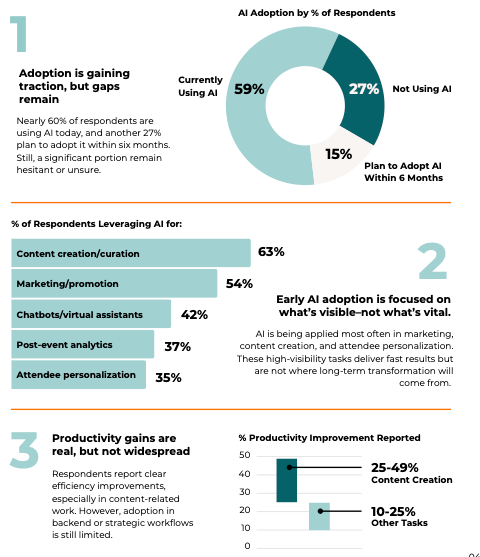
About half of organizations are currently using AI at some point in the event-planning process, according to the newly released “The AI Impact on Workforce Dynamics in Business Events” report from Soundings, a staffing and recruitment consultancy that focuses on the meetings and events industry. Most of these early adopters are using AI assistants for content and marketing purposes rather than more fully integrating gen AI tools into their planning workflows — shining a light on areas of opportunity.
Read the full Phase I “The AI Impact on Workforce Dynamics in Business Events” report from Soundings.
Slightly more than 200 event industry professionals participated in the survey, which was conducted from February through April. Soundings sourced participants through its professional network, other industry communities, and targeted email and social-media campaigns. Around 7 out of 10 of those who participated in the survey have more than a decade of experience in meetings and events, and nearly half manage events with 1,000-plus attendees.
“We launched this study to better understand how the meetings and events industry is engaging with AI, so we can equip both our clients and our talent to adopt it in ways that add value, increase efficiency, and drive stronger outcomes,” Tracy Judge, CMP, founder and CEO of Soundings, told Convene. Compared to other sectors like manufacturing and banking, the business events industry is lagging behind in terms of AI adoption — 41 percent of survey respondents cited no immediate need to use AI in the planning process.
 Subscribe to Convene.
Want deep-dive insights on events delivered to your inbox? Sign up for our newsletters.
On the other hand, some event planners are going deep with AI tools — more than one-third said they are using AI to augment attendee personalization and 37 percent to streamline post-event analytics processes.
The survey results pointed to a need for education around using AI to plan meetings and events: More than three-quarters of respondents reported they are seeking training, use cases, and guidance.
How Planners Are Using AI for Meetings
In general, most planners are using AI for marketing and content rather than as part of strategic workflows. Judge sees this as a missed opportunity. “Research shows that when AI is embedded into workflows, not just used at the surface, it drives real performance. A study from Harvard Business School found that AI-augmented teams were three times more likely to produce top-tier solutions, completed tasks 25 percent faster, and delivered 40 percent higher quality outcomes than teams not using AI.”
At Soundings, Judge said she uses AI to build internal workflows for talent matching, from the initial search through interviews and contracting, and not only have the tools increased efficiency and consistency and saved her team time, they have ensured higher-quality matches.
She shared an example of a freelance planner from the Soundings network who saw similar benefits from using AI. The planner recently used generative AI tools to analyze past F&B consumption patterns for a major industry conference and then built equations to forecast upcoming F&B needs with greater precision. “She saved planning time, reduced the team’s mental load, and delivered highly accurate guarantees. The client was so pleased with the outcome, they’ve already invited her back for next year’s event,” Judge said.
That said, you can’t just dump years’ worth of internal data into ChatGPT and hope for the best. Before integrating AI into the event-planning process, it’s important to understand where AI is a help and where it might be a hindrance. “Business transformation requires more than introducing new tools. It depends on understanding workflows and workforce capabilities. Without that foundation, it’s difficult to identify where AI can create the most value, which leads to inconsistent use, missed opportunities, and a lack of confidence among teams,” Judge said. “To measure meaningful AI integration, event leaders should focus on metrics tied to strategic outcomes, operational gains, and workforce impact. The real knowledge gap lies in helping professionals see how AI integrates into their day-to-day processes and how it can enhance the way they work.”
Getting Emotional
The next phase of Soundings’ study will explore how different factors, including emotional drivers, affect progress in AI adoption and integration within the business events industry with twin goals: to shape industry conversations around AI readiness and give leaders tangible benchmarks to drive real change. “If we want to drive real progress, we need to understand both how people work and how they feel. That’s the key to building meaningful strategies for AI adoption,” Judge said.
“We soon realized that to truly help individuals and organizations move forward, we had to go deeper. Progress with AI isn’t just about behavior,” she said, it’s shaped by emotions. “Whether someone feels optimistic, overwhelmed, or cautious plays a major role in how they engage with AI,” Judge said. “AI is personal. This isn’t the time to act like emotions have no place in business. They always matter, but especially now, when people are being asked to adapt quickly and navigate something unfamiliar.”
Forward-thinking organizations need to invest now, Judge said, in educating their stakeholders on the benefits of leveraging AI technology for their events — delaying AI tool adoption will come at a steep cost. “In two to three years, you won’t need a survey to tell who used AI and who didn’t. You’ll know because the people who didn’t will be the ones without jobs. This isn’t fear-mongering. It’s already happening. Amazon’s CEO said AI will shrink their corporate workforce because it’s being built into everything. Microsoft laid off thousands to prioritize AI. This is the new normal,” she said.
“In the events industry, it’s no different. If you’re not thinking about how AI fits into your workflows, your talent strategy, and your planning cycle, you’re already behind. The ones who succeed won’t be the ones dabbling with tools. It will be the ones who moved fast, worked smarter, and treated AI like a real business strategy, not a side experiment. If we want a future, we need to build it now. That starts by taking AI seriously before it decides for us who stays in the game.”
3 Steps to Moving Forward With AI
Judge shared the following three steps that leaders in the industry can take today to move AI from an experiment to a sustainable strategy:
1. Assess current workflows for AI integration opportunities across your planning, marketing, and operational processes.
2. Identify your team’s AI personas and create an upskilling roadmap, ensuring your people are equipped to adopt and leverage AI confidently and effectively.
3. Pilot AI-driven workflow optimization across selected events or planning processes to measure impact, gather insights, and refine your broader strategy.
Tracy Judge will lead the workshop “The New Talent Blueprint: Rewiring Event Marketing Teams for the Future of Work” on July 29 at 12:45 pm at the upcoming CEMA Summit.
Kate Mulcrone is Convene’s digital managing editor.