 Log In

Jamie Nesbit, a doctor of physical therapy, led trainings for the Parkinson Ready Phoenix initiative.
When the World Parkinson Coalition was preparing to launch the World Parkinson Congress more than two decades ago, its leaders asked themselves a groundbreaking question, said Eli Pollard, WPC’s executive director: “Why don’t we have a global meeting for Parkinson’s where patients are invited to participate?”

Eli Pollard
The first congress, held in Wash- ington, D.C. in 2006, was attended by more than 3,000 people, 1,000 of whom were people living with Parkinson’s and 1,800 were neuroscientists, clinicians, and other specialists. Feedback from participants was, for the most part, overwhelmingly positive, Pollard said. Advocates, the term WPC uses to describe participants with Parkinson’s, were “over the moon” to have access to world leaders in Parkinson’s research and treatment, she said. For many of the research scientists, it was the first time they’d had a chance to talk to someone with Parkinson’s about the disease.
But the arrival of hundreds of people with Parkinson’s for the conference had created confusion at hotels, Pollard added. Congress participants said “they wished we had done something in the city to prepare hotel staff.”
“A lot of times the feedback you get isn’t necessarily something you can address,” she said. “I remember reading that feedback and thinking: ‘We can do something about this.’”
Before the next gathering of the triennial meeting, held in Glasgow, Scotland, in 2010, Pollard reached out to the Glasgow City Marketing Bureau (now Destination Glasgow), for ideas on how to help make the hospitality community aware of the needs of Congress delegates in advance. “We can help get people to the table,” Molly Doheny, then-head of the convention bureau, told Pollard, “if you bring in the trainer.”
Working with the nonprofit Parkinson’s UK, Pollard, who also serves as chief of education and training for the U.S.-based Parkinson’s Foundation, created a basic training program aimed at hotel, convention center, police, fire, and airport staff — “anyone we thought might come into contact with our delegates,” she said.
The training sessions, delivered by a Parkinson’s disease nurse specialist, covered the core aspects of what people might encounter in people with Parkinson’s, including difficulties with speech and movement, Pollard said. Participants also learned that Parkinson’s is a complicated, multisystem disease with a wide range of symptoms that often fluctuate. “No two persons look alike,” Pollard said.
Training also focused on the best ways that people in different roles could offer support to meeting delegates. “If you don’t know what it means for someone to have Parkinson’s and you don’t know how to help, it can make you feel uncomfortable,” Pollard said. “We don’t want people to feel uncomfortable. We want them to feel like this is natural — people with Parkinson’s have this every day.”
The program delivered in Glasgow was “wildly successful,” Pollard said, and the Parkinson Ready program has been repeated in each of the five destinations where the triennial conference has since been held, including Phoenix, where WPC met in May. In each destination, WPC connects with local partners, and in Phoenix, that included the Muhammad Ali Parkinson Center. Together the WPC and MAPC identified two trainers and together they took part in all of the Parkinson Ready programming, Pollard said. “They sat on our steering committee, helping us make sure it was really “We want the city to be better off when we leave.” going to hit the spot for the local community.”
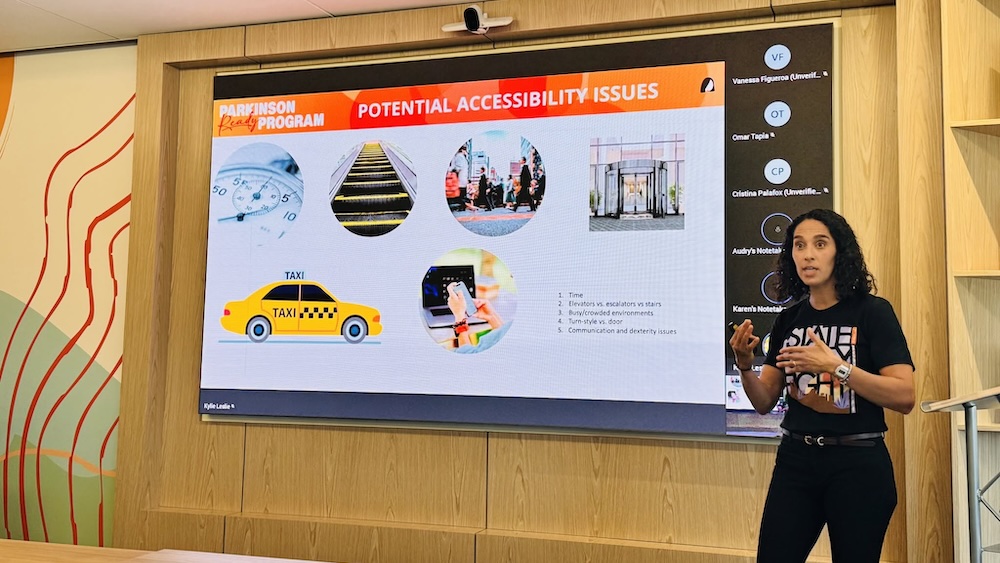
Another linchpin was Kylie Leslie, assistant director of destination services for Visit Phoenix, who acted as a liaison between WPC and Phoenix’s hospitality community and other support staff. More than 400 people completed training in nine different sessions, Leslie said, including banquet, housekeeping, security and other staff at the convention center and four Phoenix hotels. EMTs, public transit employees, and staff from the police and fire departments also were trained, along with the Downtown Phoenix Ambassadors, safety and hospitality teams who work on Phoenix streets. The Phoenix Convention Center is owned by the City of Phoenix, which made the training available to all city employees, and Visit Phoenix invited staff from area destination organizations to trainings, she said.
Each training session lasts for about 75 minutes, including a Q&A when participants often offer suggestions based on their own experiences, Pollard said. For example, an employee on the housekeeping staff at a Phoenix hotel suggested that, during the con- ference, staff lengthen the amount of time they wait after knocking before entering guest rooms from three seconds to 10 seconds, to give people more time to answer or to come to the door, she said. In another example, after learning that WPC participants would be attending a baseball game in downtown Phoenix, a city employee suggested that police directing traffic near the ballpark give pedestrians extra time to cross the street that evening.
 Subscribe to Convene.
Want deep-dive insights on events delivered to your inbox? Sign up for our newsletters
There’s not yet official data about the impact of the training on WPC delegates with Parkinson’s, but it was “very, very, very obvious” that it contributed to their com- fort, Pollard said. “Phoenix went above and beyond.”
In the few months since the WPC, “we’ve already seen the confidence level of our staff go up when it comes to working with groups with medical conditions,” Leslie said. In addition to making sure staff had the skills they needed to make WPC delegates feel welcome, the training was an opportunity to improve the destination’s ability to help visitors of all ability levels feel welcome in Phoenix, said Leslie. “So many of the skills that we taught the staff at the hotels and the convention center and beyond are applicable to all different types of conditions and ability levels.” Along with the goal of making sure that people with Parkinson’s felt welcome, safe, and secure in destinations hosting WPC, Pollard said, “we really want to leave a legacy behind. We want the city to be better off when we leave than before we arrived.”
Making a Wider Impact
According to a study conducted by the Montreal-based nonprofit MEET4IMPACT following the 6th World Parkinson Congress in 2023 in Barcelona, more than 30 percent of people who went through the Parkinson Ready training reported using it in their workplaces, said Pollard, the program’s developer. What was even more striking to Pollard was how far the awareness raised by the training spread. More than 90 percent of those trained reported talking about it in their workplaces, and more than 80 percent said that they used the information in their personal lives. That’s important, Pollard said, because Parkinson’s is the fastest- growing neurological disease on the planet. “There is just such an incredible need for elevating awareness about the complexities of this disease in the workplace and in our personal lives.”
Barbara Palmer is Convene’s deputy editor
Learn more about the Parkinson Ready program.