 Log In

 Not Sleeping On It
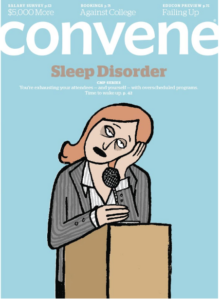
In our June 2015 cover story, we challenged the industry norm of conference agendas so jam-packed they make sleep deprivation almost inevitable for attendees and meeting organizers. Exhausted attendees told planners they had trouble remembering what they learned, we reported, and planners, in a kind of “boastful masochism,” took pride in their ability to work long hours.
A decade later, the signs that we are waking up to the negative effects of sleep deprivation are everywhere. The American Optometric Association (AOA) offers a “sleep-in” registration for the AOA Foundation’s early-morning 5K run, and initiatives like Event Minds Matter Empowered by Club Ichi encourages meeting professionals to recognize the cost of stress and sleep deprivation and prioritize their own and their staffs’ mental health.
From “Wake Up!,” June 2015
 A More Inclusive Face-to-Face Future
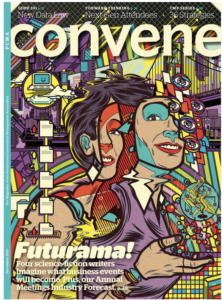
When we asked four science fiction authors to help us imagine the future of conferences for our 17th annual Meetings Industry Forecast in 2017, writer Tom Merritt’s observation about how technology would impact on the demand for in-person meetings hit it on the nose: “One of the constant misperceptions is that we meet at conferences in order to see each other, and that if technology makes it easier to do telepresence or videoconferences, that would somehow become less necessary. … I think fundamentally we like to meet in person because there’s just a different dynamic.”
Author Madeline Ashby also was prescient in predicting that changes aimed at making events more physically accessible would expand to include people who are neurodivergent. The Neu Project, which distributed guides and checklists for producing neuroinclusive events, debuted in 2022.
From “How Do Sci-Fi Authors Imagine the Future of Meetings?,” October 2017
 Subscribe to Convene.
Want deep-dive insights on events delivered to your inbox? Sign up for our newsletters
 Disruption, Meet Integration
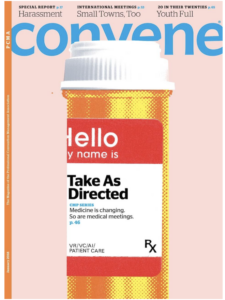
Virtual reality made the list of technologies that our January 2018 cover story predicted would disrupt medical meetings. “VR technology will break down the barriers between teachers and learners,” said Brennan Spiegel, M.D., director of health research at Cedars-Sinai Medical Center in Los Angeles, who delivered what is thought to be the first “mixed reality” CME lecture in 2017.
Initiatives like the American Academy of Ophthalmology’s VR Education Program, a free VR platform for pediatric ophthalmologists and students which has been adopted in 60 countries, are demonstrating VR’s ability to reach global audiences who otherwise might lack access to training.
And VR’s presence at medical meetings today looks less like disruption than a powerful integration. At the American Academy of Orthopaedic Surgeons (AAOS) Annual Meeting, VR is woven into CME-accredited sessions — as Spiegel predicted, and in the Exhibit Hall, where exhibitors use VR to demonstrate new techniques and products.
From “The Future Will See You Now,” January 2018
Barbara Palmer is Convene’s deputy editor
Read more from our archives in a story about Convene’s 30th anniversary.