 Log In


When planners build restorative breaks into meetings, participants thrive, writes author and design strategist Natalie Nixon. Here, an attendee at the Seattle Convention Center’s Summit building.
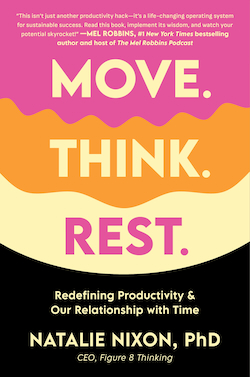
Creativity and design strategist Natalie Nixon, the president of Figure 8 Thinking and a global keynote speaker, has followed her own career path — earning degrees in anthropology, African studies, textiles, and a Ph.D. in design management, and finding business inspiration in the world of jazz. Nixon’s most recent book, Move. Think. Rest. Redefining Productivity & Our Relationship with Time, also challenges convention and our fundamental assumptions about how people do their best work, including what Nixon calls the “glorification of busyness” and the idea that productivity means grinding through tasks and checking off boxes.

Natalie Nixon. Photo courtesy Aliza Schalabach.
In an era when AI, automation, and robotics are rapidly advancing, “the true opportunity of this revolution lies in rethinking productivity,” Nixon writes in Move. Think. Rest. Instead of fearing that AI will replace us, Nixon suggests that technology will give us the time and freedom to focus on the things that make us uniquely human. “What if,” she asks in the book, “we moved away from our dated model of productivity based on efficiency measured in speed only,” and considered “that our most productive selves are when we give ourselves the space and time to move, think, and rest?”
Nixon has distilled research and insights from multiple fields about how those three activities — moving, thinking, and resting — impact creativity and productivity into what she calls an MTR framework. “Our brains aren’t machines — they need rhythm, not relentlessness,” she wrote in an email to Convene, “and blocks of suspended time where we’re not racing against the clock. When bodies are in motion, ideas flow more freely. And rest is non-negotiable.”
When we asked Nixon how she would apply the MTR framework if she were designing a two- or three-day meeting, here’s what she had to say:
 Normalize session moratoriums
Designate specific blocks — maybe the first three hours of Day Two, or every afternoon — as session-free zones. This isn’t break time; it’s deep work time. People can use it for reflection, one-on-one conversations, or processing what they’ve learned. This single change can transform a conference from overwhelming to generative.
Create “movement infrastructure”
Design for circadian rhythms
Schedule cognitively demanding sessions during peak focus hours (usually mid-to-late morning for most people) and more collaborative, creative sessions in the afternoon. Build in longer breaks around natural energy dips. This honors the biological reality of how humans function rather than forcing people to override their bodies’ signals.
Create rituals of rest
Not just scheduling breaks but designing them. Perhaps start each day with 10 minutes of optional guided meditation or stretching. End each day with a brief reflection session. Normalize the afternoon power nap by creating designated quiet spaces. When rest becomes ritualized rather than something people grab guiltily, it transforms the culture of the entire event.
Measure differently
Stop evaluating meeting success solely by how much content was covered or how many hours people spent together. Instead, ask: What new connections formed? What unexpected insights emerged? How energized do people feel? This shift in metrics naturally leads to different design choices.
Where the Real Magic Happens
“When event planners embrace MTR as core design principles rather than nice-to-haves, they create conditions where people don’t just attend meetings, they flourish within them,” Nixon said. “And that’s when the real magic happens: ideas that couldn’t have emerged through sheer force of will, connections that spark innovation, and energy that sustains long after people return home.”
Barbara Palmer is Convene’s deputy editor