 Log In

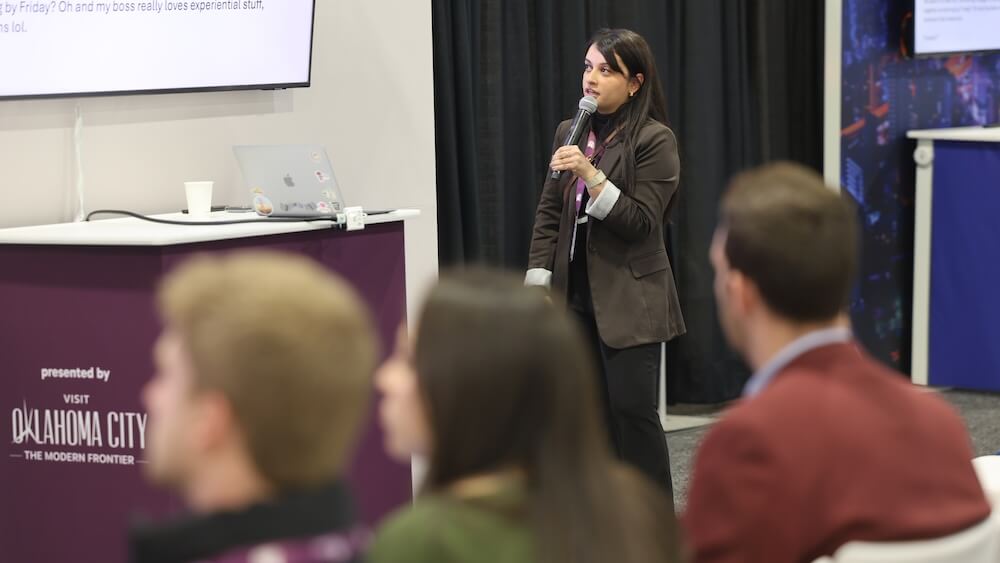
Gevme’s Keerat Singh introduces the Spark Hackathon challenge. Photo by Jacob Slaton / Whatever Media Group.
Things moved quickly for Patricia Guidetti, DES, senior director of programs for the National Alliance for Public Charter Schools, when she arrived at the Convening Leaders Jan. 13 Spark Hackathon at the Pennsylvania Convention Center with “a laptop and a dream,” but no fellow team members. “Literally five minutes” before the hackathon’s challenge was revealed, Guidetti, Lisa Garcia, CAE, executive director of the International Association for Food Protection, and Toni Carle, national sales manager for The Equinox Golf Resort & Spa, in Manchester, Vermont, introduced themselves to each other and decided to team up, she said.
Then came the challenge: to respond to an RFP from a potential client, sent in the form of a meandering message written by an inexperienced staff member. “The best way that I could describe it,” Guidetti said, “is that a newly hired intern sent out an email and had very little idea of what they actually needed for the event.”
For the next 30 minutes, Guidetti, Garcia, and Carle raced the clock — and two other teams — using Spark and other AI tools to create a presentation with all of the following elements: an event concept, a sample run-of-show for the event’s first day, an attendee journey map, a pre-event marketing email sequence, speaker and session recommendations with rationales, follow-up questions for the client, a budget framework, and metrics for what success would look like for the client.
Together, the three-person team designed an experiential executive sales retreat in California’s wine country, with wine-blending as a theme — and by the end of the hour, were named the winners, earning them free registration to a 2026 PCMA event of their choice.
Competition from the other participants was stiff, Guidetti said, and included some returning members of a student and faculty team from Texas A&M — winners of the Convening Leaders 2025 hackathon. But getting thrown headfirst into the challenge with strangers turned out to be a unique opportunity, Guidetti said. The diversity of experience on her team — an association executive, a hotelier, and Guidetti, who oversees event marketing, promotion, and logistics — ended up being a strength, she said. “We were able to see [the challenge] from a variety of different sides.”
The team’s combined experience did help them stand out, said Logan Mitchell, the vice president for convention sales for Visit OKC, who judged the presentations along with Keerat Singh, chief revenue officer at event tech company Gevme, Spark’s developer, and Chantal Sturk-Nadeau, PCMA’s vice president for innovation and insights. Deciding on the winning team was tough, Mitchell said in an email to Convene. “Everyone utilized AI in such impressive ways and managed to create very detailed presentations in a short amount of time.” The Guidetti/Garcia/Carle team’s edge over competitors, Mitchell wrote, was in how they “put together engaging team events, thoughtful budgets, and delivered everything very clearly.”
Hackathon participants used the upgraded Spark 2.0, which had been launched just one day earlier (see “Meet Spark 2.0,” below). Guidetti has just begun to explore the new interface, she said, but she immediately liked Spark’s redesigned chat feature, which was where her team spent most of their time, creating such a detailed prompt that they hit its 4,000-character limit. “The more specific information that you put into the AI platform,” Guidetti said, “the more specific information you’ll get back.”
 Subscribe to Convene.
Want deep-dive insights on events delivered to your inbox? Sign up for our newsletters.
Learning Curve
The hackathon was a whirlwind, but Guidetti’s experience using Spark and AI has been a years-long journey, she said. As an early Spark adopter who had dabbled with ChatGPT, Guidetti could see in comparing the two that when “it comes to the event side of things, how much more clarity there is to the responses I get because of how Spark is trained to think as an event professional.
“But you have to be able to think of Spark as more than a search engine or something that helps you rewrite emails,” she added, “because that’s not really using it to its full potential. There’s a learning curve to that, and it’s not necessarily a simple thing.”
At the National Alliance for Public Charter Schools, Guidetti recently used Spark to analyze attendee data from the association’s last annual conference and, after combining it with the results of a question asked during the registration process — what registrants wanted to get out of the event — was able to personalize education sessions and networking opportunities for different audience segments, she said. “Normally that would take months of data analytics,” but Spark “spouted it out in maybe five minutes.”
She also created a messaging map based on the conference’s content pillars, and used Spark to help write personalized marketing messages, including social media, for the different segments.
When asked about the overall impact that developing expertise with Spark has had on her work, Guidetti told Convene that it helps her “think through some of the more logical things like workflows and email cadence — things that are more formulaic — and it makes that part easier. And it gives me more opportunity to think about the creative aspects of event planning and event management — some of those little touches, like thinking through how the energy is going to be in the transitions from the general session to the coffee break that aren’t something that AI is necessarily going to think of.
“Saving time on some of those smaller, more repetitive tasks allows me to edit and think more strategically — and to think about the future of the event in ways that I haven’t necessarily had the time to do in the past.”
Meet Spark 2.0
PCMA launched Project Spark in 2023 as a research initiative, to give event professionals access to a custom gen AI tool for business events. Now simply called Spark, the platform has continually expanded in size as well as scope — Destinaitor, a destination and venue search tool, was introduced last year.
On Jan. 12, Spark debuted a major upgrade, based on feedback from users and designed to make things simpler and more intuitive, said Singh.
“When we started Spark, we started thinking through it as being task-based,” Singh told Convene. For example, “if you want to create a session description, that’s one task. You want to write a press release, that’s another task,” she said. Last year, “when the ‘chat’ feature was introduced” — a feature analogous to the prompt bar in other AI tools — “it was presented as one more option, one that gave users the flexibility to work outside of the tasks.” One of the most prominent changes to Spark 2.0 is that the “chat” feature has been moved to the center of the homepage, and allows users to choose from a menu of multiple large language models (LLM).
Other features in the redesigned platform include:
- More than 30 languages
- A task library, simplifying finding and choosing among the platform’s 150-plus tasks.
- Curated pathways for tasks for five user categories: event planner, marketer, DMO, supplier/vendor, and hotel/venue.
- A “Learning Academy” with on-demand training on topics ranging from event data analysis to creating custom workflows. In the past, “a lot of people have gone to Spark and thought: ‘It’s too much!’ Singh said. “We want Spark to be a place where users can come for education.”
Barbara Palmer is Convene’s deputy editor.
Explore Spark at sparkit.ai.