Log In


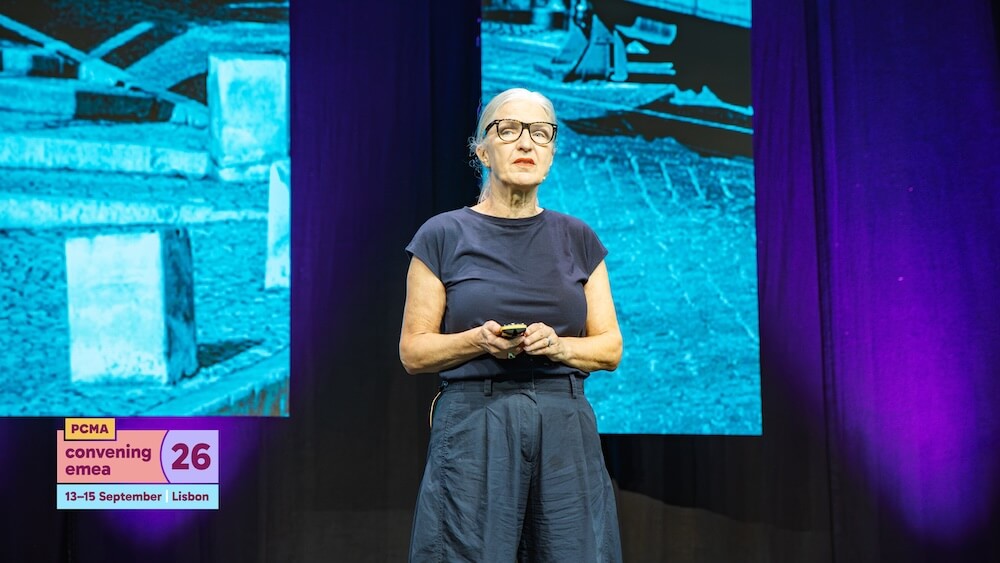
Anne Lise Kjaer, a globally recognised futurist, and founder of Kjaer Global, spoke about why trust is in the doldrums at Convening EMEA 2026. Photo courtesy Convening EMEA 2026.
Presented by New Orleans Ernest N. Morial Convention Center and New Orleans & Company
Anne Lise Kjaer is a globally recognized futurist who has helped some of the world’s leading companies anticipate and navigate change. Looking ahead, she sees technological change coming at super-speed, she told an audience in Lisbon at Convening EMEA in September, where she was a keynote speaker.
“We see geopolitical risk and tension on the rise. And then there’s the well-being of planet and people — it’s in vast decline” and perhaps why trust is at an all-time low, Kjaer said. “The future is complex, it’s safe to say.”
Kjaer’s observations are echoed in the responses of the participants in the room at Convening EMEA, as well as responses to industry surveys. More than half of corporate planners (55 percent) said geopolitics has changed how they plan, according to the PCMA 2026 Outlook Report.
Falling or frozen budgets were also having an impact — 60 percent of corporate planners reported budget reductions, according to the Outlook report, and more than 90 percent of planners who responded to the 2026 Meetings Market Survey said inflation had impacted their events this year. Six out of 10 meeting professionals who work in DMOs and one in three association planners named geopolitics and the economy as the factors that were having the most impact on their roles. For one-third of the meeting professionals surveyed for the American Express 2027 Global Meetings and Events Forecast, risk management was listed as a top priority for the coming year.
As the complexity and challenges of their jobs multiply, seven out of 10 corporate planners said their roles have become more proactive than they were five years ago and 60 percent said they, like Kjaer, were “expected to predict the future.” But fewer than one in five (17 percent) said they felt equipped to assess future risks, according to the Outlook report.
In Lisbon, Kjaer offered some guidance for meeting professionals under pressure.
 Subscribe to Convene.
Want deep-dive insights on events delivered to your inbox? Sign up for our newsletters
“Foresight is not about predictions” or trying to see how far you can see into the future, she said. “It’s about being prepared. It is very much about spotting the early signals on the horizon in order to understand what’s noise and what is really going to affect us in the long term.”
War, Heat, and Dissent
Politics and the weather were more than background noise in 2026 as war, heatwaves, and government policies canceled, postponed, and complicated events of all sizes, including:
› Postponed: The World Economic Forum (WEF) Global Collaboration and Growth Meeting, which was to gather 1,000 global leaders, policymakers, economists, and business executives together in April in Jeddah, Saudi Arabia, was postponed because of airspace disruptions and military escalation in the Middle East. Thousands of flights in the region have been canceled since the 2026 Iran War began Feb. 28, including more flights canceled in October after missile and drone attacks closed airports in Saudi Arabia.
› Canceled: A London Climate Week event titled, “Extreme Heat: Improving Governance and Strengthening Action Around the World,” scheduled for June 24 at the London School of Economics, was canceled due to a heat wave and because the Victorian-era space where the event was to be held is not air conditioned. Organizers also cited the danger high temperatures posed to participants inside the venue and while traveling to the event.
› Unsettled: More than 2,000 mathematicians signed a petition launched in March to move the 2026 International Congress of Mathematics (ICM) meeting from Philadelphia, citing the suspension of visas from 75 countries, U.S. military actions in Venezuela and Iran, and the presence of federal Immigration and Customs Enforcement (ICE) agents in major U.S. cities. The meeting went on as scheduled in July and ICM’s organizer, the International Mathematics Union, made all sessions available online, including prerecorded lectures by some of the speakers who were blocked from attending or who participated in the boycott.
Barbara Palmer is Convene’s deputy editor