 Log In

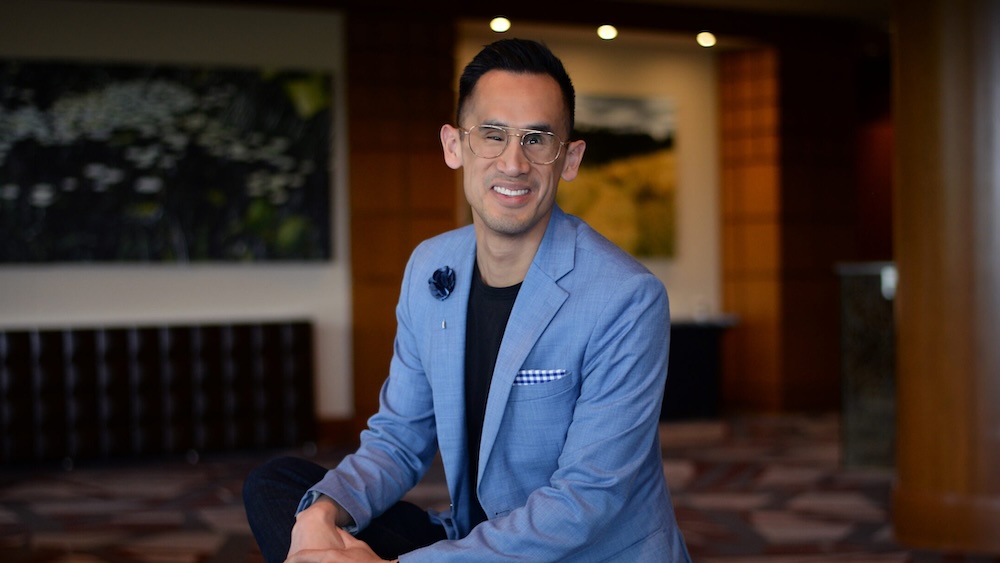
Jay Kiew will open his session by breaking down what it truly means to lead in an era where digital disruption and AI move at supersonic speed.
Jay Kiew started his career in the corporate world, with stints at Deloitte, TELUS, and ADP, before pivoting to become a change navigation strategist and professional speaker. He’s also a half-blind cancer survivor, so he’s able to hold up his own experience as a testament to resilience in the face of adversity. Kiew will join fellow keynoters Erin Stafford and Jahkini Bisselink on the Convening Leaders Main Stage for an “Igniting Performance and Possibility” session. He will unpack the behavioral science behind our relationship with disruption and guide Convening Leaders attendees on strategic ways to navigate change.
After his talk on the Main Stage, he will join Erin Stafford and Jahkini Bisselink for a conversation on performance, purpose, and leading with heart in a world that never stops changing hosted by Holly Ransom. Kiew is also leading a Masterclass on change fluency on January 12 at 11:00 am. In an interview via email, Kiew gave us a sense of what the CL audience can expect.
 Subscribe to Convene.
Want deep-dive insights on events delivered to your inbox? Sign up for our newsletters
What will you be talking to the Convening Leaders audience about and what do you hope they’ll gain from your insights?
Navigating this era of digital disruption can often feel like we’re journeying into uncharted territory, especially as AI rockets ahead at supersonic speed. While we strive to curate meaningful event experiences, we grapple with absorbing constant change, upskilling ourselves with the latest technology, and figuring out what our attendees want most.
As event professionals, how do we maintain the balance between leveraging cutting-edge technology and preserving the sparks of human connection? Most importantly, in an era where every conference can access the same AI tools, the same virtual platforms, and the same engagement technology, how do we, as event strategists, create differentiated experiences?
At Convening Leaders, I will unpack how we might reinforce our ability to speak the language of change. I aim to provide event strategists with a leading playbook to skillfully navigate the evolution of the events industry in the age of agentic AI, while keeping attendee experience and community impact at the center.
Can you explain how your concept of Change Fluency — which you’ve trademarked —differs from the more traditional notion of change management?
Think about the biggest change disrupting your life lately. Maybe it was a professional change like moving to a new organization, function, or job, or a personal one like adding a new family member, caring for aging parents, or planning a wedding. How did you interpret that change? As a threat or as an opportunity? How did you respond to that change? Were you frozen, resistant, and stuck, or were you proactive and adaptive?
When we get hit with disruption, most people try to shift what they do, but peak performance actually comes from transforming how we think. While change management is a methodology, change fluency is a mindset that shapes an individual’s adaptive capacity to translate challenges into opportunities. This single mindset shift allows us to drive transformation, first within ourselves, then our teams, and finally our organizations.
Are there any soft skills that leaders can work on in order to make the most of emerging technologies like generative AI?
For anyone wanting to reinforce seeing change as an opportunity and being able to proactively adapt to it, Change Fluency builds upon three core skills that anyone can get better at. The first is vision-casting, which is using strategic foresight to discover what’s possible. The second is working in wonder, which means using design thinking to shape the future, and the third is to create with care, meaning that we can use care as a competitive advantage to differentiate from the standard experience.
Catch Jay Kiew on the CL 26 Main Stage on Monday, January 12 at 8:45 am and attend his Masterclass on January 12 at 11:00 am.
Kate Mulcrone is Convene’s digital managing editor.