 Log In

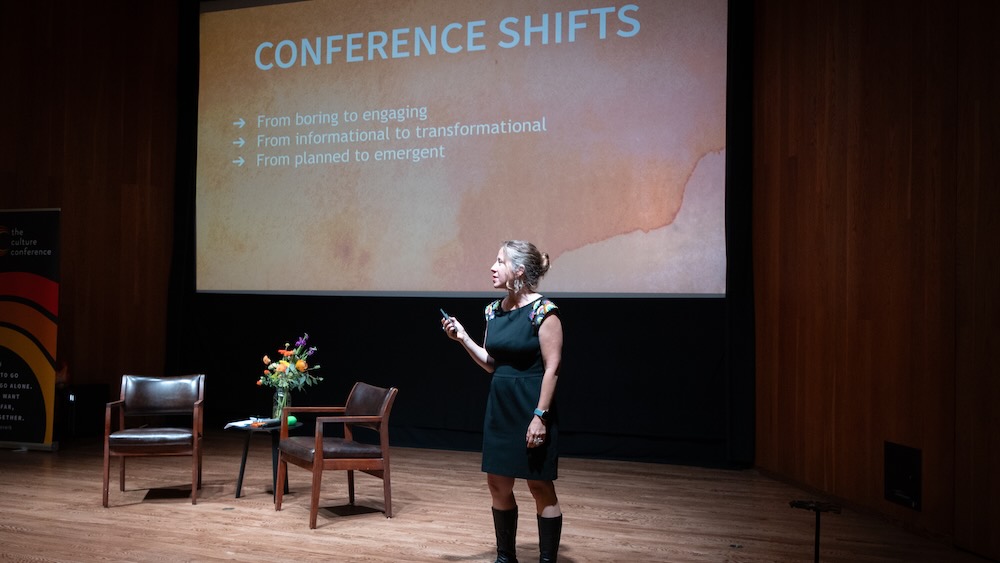
Jenny Sauer-Klein, founder of The Primary Shift workplace experience design studio, brought 150 participants together to talk about how to build connection and impact at the inaugural The Conference for Conferences. Photo by Selina Pan
The traditional conference paradigm — “sit-and-listen, passive-observer, information-overwhelm — is broken,” said Jenny Sauer-Klein, the founder of The Primary Shift, a San Francisco Bay Area–based workplace experience design studio. “It’s done.”
“We have the internet at our fingertips, we have AI. If it’s just about information, we can do that at home alone on our couch anytime for free,” Sauer-Klein told Convene. “So why are you getting on planes and trains and automobiles, leaving your family, letting go of your to-do list, to be in a room full of people who care about the same thing you do?” In her experience, what people are really looking for is the chance to build meaningful relationships in ways that are going to continue after an event, with people who will become friends, mentors, clients, and collaborators, she said. “We need to shift the conference paradigm to say, ‘How do we maximize the live, group, in-person experience?’ And that’s a totally different way of orienting to what a conference is.”
On Sept. 16, Sauer-Klein convened the inaugural The Conference for Conferences on the campus of the Oakland Museum of California, where the event’s 150 participants were invited to experiment with session formats and imagine new ways to convene. The day’s speakers included those Sauer-Klein described as being “behind the scenes making the magic happen at bigger conferences and events,” including Tahira Endean, IMEX’s head of programming, and Raven White, director of audience development and community for TED. “Specifically, I was looking for people who are in some way innovating the art form,” she said. The event was meant to pull the curtain back on how those professionals work but also to model lessons from her own experience as an organizer — Sauer-Klein also is founder and director of The Culture Conference, an invite-only event for business leaders who want to build a positive workplace culture.
The Conference for Conferences took a few steps back from technology, which can be a distraction, Sauer-Klein said. “When people are coming into an in-person space, they want to be with people, not with technology.” There was no event app — in its place, participants got pretty pens and an 8×8-inch paper workbook, which held the printed schedule, speaker bios, and lined pages for notetaking. Participants wrote their first names only on stick-on paper nametags. “We wanted participants to get to know one another as persons,” she said, “not to lead with their job titles.”
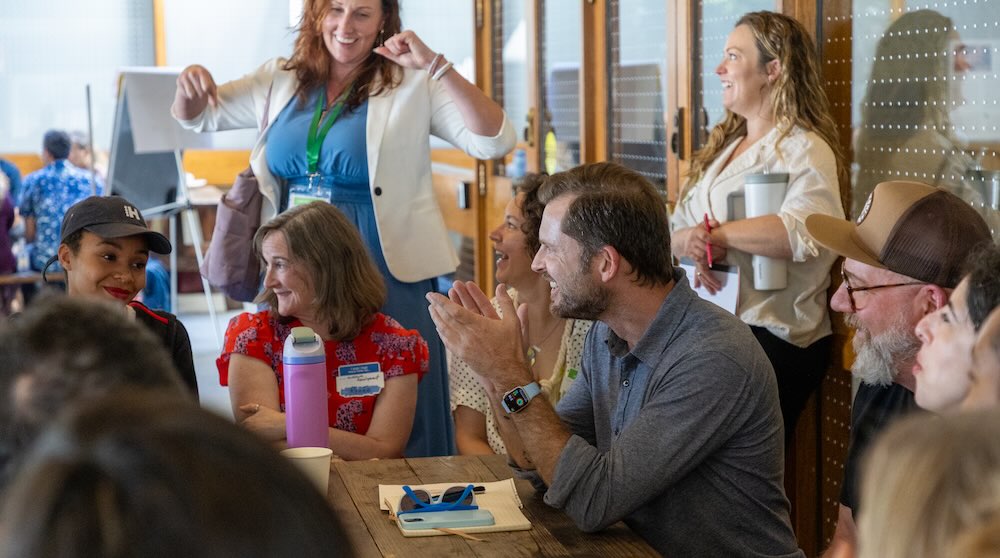
World Domination Summit founder and Conference for Conferences speaker Chris Guillebeau, center, shares ideas in a breakout. Photo by Selina Pan.
Flipping the Script
The schedule — with morning and afternoon sessions, a break for lunch, and a “golden hour” closing session in the museum’s gardens with a band and food and drink — didn’t look particularly revolutionary on its face, Sauer-Klein said. But the devil is in the details, she added, and one of the hallmarks of the day was that the event flipped the script on the familiar 45-minute presentation followed by Q&A session model. The longest presentations, including keynotes, were 20 minutes, and the main stage plenary sessions more closely resembled interactive experiential workshops than “talk-at-you” kinds of sessions, she said.
Tucker Bryant, a former Google product manager turned poet and corporate consultant, set the tone for the conference in an opening keynote about poetic principles, including the idea that “we write by erasing,” Sauer-Klein said. He asked the question, “What can you take away in order to make space for something new to come through?” — which introduced the perfect mindset for looking at what could be let go of or rewritten in a new way at conferences, she said. In the opening session, everyone shared one cool thing they’d seen or done at a conference. “So right from the start,” she said, “we’re starting to share ideas.”
 Subscribe to Convene.
Want deep-dive insights on events delivered to your inbox? Sign up for our newsletters
The morning session included an exercise aimed at reinventing four traditional conference formats — keynotes, breakouts, fireside chats, and panels. Participants, including speakers, were divided into small groups, and asked to come up with five ways to make one format more interactive, engaging, and experiential, writing down their ideas on index cards and then sharing them with the room. In another session, speakers led participants in conversation about how they could incorporate elements of lesser-known, more inherently interactive session formats — including fishbowls, hackathons, and unconferences — into their thinking and events. Sauer-Klein used technology to capture conference content but kept it behind the scenes, scanning the index cards and recording conference sessions, which AI then mined for insights to be sent to participants after the event.
A sense of play was also embedded into the day, a quality that often is missing at many events, she said. “Conferences get so serious and they’re so heady — they’re very intellectual and cerebral. Can we bring in fun?” she asked. “Can we bring in movement?”
To shake up a fireside chat with Chris Guillebeau, the founder of the World Domination Summit and NeuroDiversion 2025, Sauer-Klein curated bowls full of “Truth or Dare” prompts for Guillebeau to choose from. He chose dare — to spell out the letters of the alphabet with his body — and then invited Sauer-Klein to join in.
‘Don’t Be Boring’
“A lot of times what I say to people is just don’t be boring — which takes a lot of planning and thought and strategy,” Sauer-Klein said. “It’s very easy to be boring, and it’s what we fall into, so we have to be proactive about thinking and designing for interactivity, engagement, and experiential learning.
“I think there’s a lot of limiting beliefs that people have about how custom, how bespoke, how special, how intimate a big event can feel. And my strong belief, and I think it was echoed at the conference, is that you can absolutely achieve those things with intention and some horsepower behind it,” she said. “It definitely takes time and energy but is absolutely doable. And when you do that, people’s experience is profound. They feel seen and they feel like they matter, and it just creates a completely different culture in your event that makes people want to come back.”
Barbara Palmer is Convene’s deputy editor.
Find out more about one of The Conference for Conferences’s unique icebceaker activities.