 Log In

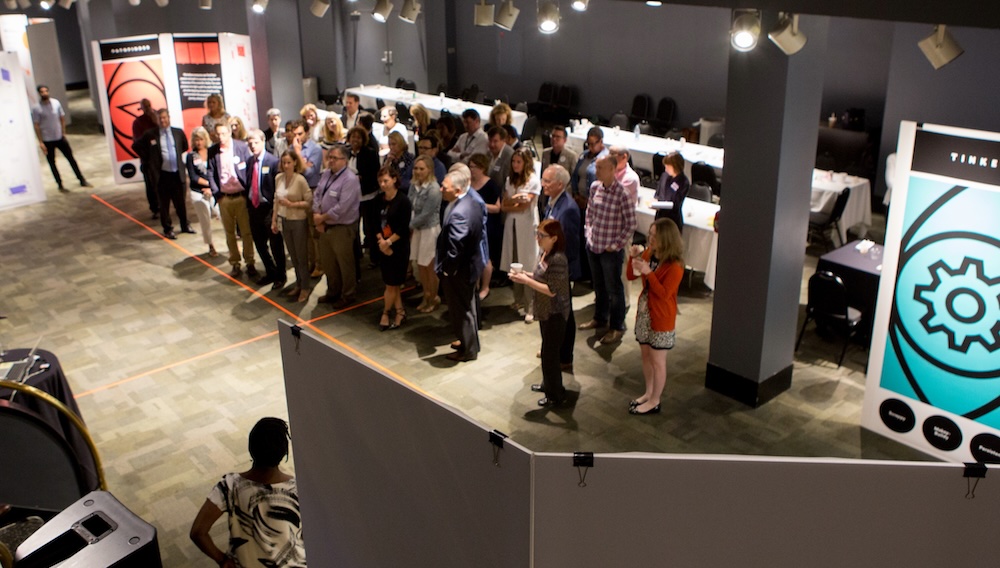
Participants take a physical stand on an issue in ‘Creative Tensions.’
People don’t leave the world at the door when they come to an event,” Alex Gallafent reminded the audience at the beginning of his PCMA Convening Leaders session, “More Than One Way to Think,” in January in Philadelphia. And the world, he added, “is complex, contested, fragmented.
Yes, people bring their hopes for connection and learning, but I also think they bring their exhaustion, anxiety, and skepticism.” Since we’re creating events “in a culture that kind of feels more and more unstable,” Gallafent said, “we might need new ways to anchor ourselves in the work.”
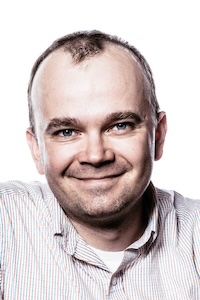
Alex Gallafent
Gallafent spent 12 years at IDEO, a company widely recognized as a pioneering leader in human-centered design thinking, before launching his own consultancy, Gallafent & Company, early this year. During his interactive session, he gave event professional participants a taste of “cognitive estrangement,” a way of stretching your thinking in order to deepen your impact. That practice, which he draws on to design and facilitate distinctive experiences for groups, involves choosing from among several “mental hats that we can put on to expand our thinking repertoire.”
Think Like a Futurist
First up: thinking like a futurist, which is not about prediction. “There’s no crystal ball,” he said. “But what a futurist can do — and what we all can do — is imagine different possible futures and prepare for them.” The process starts with recognizing signals — “think of them as ‘pockets of the future’ embedded in the present already,” he said. “They’re little things that start to stand out in the culture. They might be emergent or kind of odd or a bit uncomfortable.”
As an example, Gallafent took everyone back to the year 2000, when video-rental company Blockbuster had 9,000 stores across the U.S. Despite its big footprint, Blockbuster didn’t recognize how its model was showing signs of strain (like late fees). And the company was ignoring another signal — there was a little company called Netflix that had 300,000 subscribers who paid for the frictionless experience of having DVDs mailed to their home with zero late fees, he said. By 2010, Blockbuster had “reached the end. The old paradigm was gone and the new one was established. But in 2000, both of these futures existed simultaneously. You could get your movies from Blockbuster or you could get them from Netflix.”
The question a futurist asks, he said, is: What signals are important right now? The trick is to pay attention to what’s happening at the edges, and then — having made sense of various signals, along with deeper trends and drivers — make choices “based on where things seem to be heading.”
There are ways that events seeking to help their audiences imagine what’s ahead for them can turn futuring into a concrete experience. Gallafent shared an interactive exhibit he co-designed at COP28, the U.N. climate conference in Dubai in 2023, in which participants were able to walk through a space that showed how a world changed by global warming might look a few decades from now. That space, neither utopian nor dystopian, was filled with artifacts that brought to life the new jobs, homes, markets, and behaviors we might expect in such a future. For example, a possible future of retail bioplastics made from insects was represented by posters set in a market in Jakarta, Indonesia.
Gallafent said he thinks event professionals are particularly “well-positioned” to look for signals that point toward the future. “You see people up close all the time and en masse,” he said, “so you are much more likely than others to see new behaviors or needs popping up in culture or in groups and communities.”
Think Like a Game Designer
Game designers are “super skilled at creating conditions where people want to play,” Gallafent said, noting that there are 3.2 billion gamers worldwide. Game designers know that engagement is a choice, he said, and it’s the same for events: “We have to earn people’s attention, we have to invite participants into an experience,” he said, that they’re willing to engage with.
There are many ways to do that, including the design of rituals, he said. For example, in the fantasy tabletop role-playing game Dungeons and Dragons, opening the dice is a signature ritual to indicate that the game has begun. In his own work, Gallafent shared how he’d used ritual to enliven a serious topic for a global financial services company: by building comfort addressing the big challenges that were being left unspoken — the so-called elephants in the room. To ritualize the shift in mindset, he hid about 500 tiny elephants across the event space for participants to find as the first day began. “The ritual of finding elephants at the start of the event set the stage for the important conversations that followed,” he said.
 Subscribe to Convene.
Want deep-dive insights on events delivered to your inbox? Sign up for our newsletters.
When you have people in a physical space together, the opportunities for designing amazing experiences are endless, he said. In partnership with the Sundance Institute, Gallafent and his IDEO colleagues developed an event format called “Creative Tensions,” which he described as “a conversation that moves.” We put people in a space, he said, create a central line down the middle, and host a conversation that explores a set of statements framed as tensions between two extremes. As people hear the tension, they have to take a stand in the room on either side of the line based on where they stand on the issue. Formats like this make participating dramatically more rewarding for people, he said, than sitting through another panel.
Another way to liven things up? Shift perceptions by “setting the table” at an event in ways that upend expectations and trigger curiosity. At one event, Gallafent chose to leverage the so-called “dead spaces” in conference areas, like interstitial spaces and corridors, by adding interactive exhibits. Doing that made content stand out, he said, and invited participants to think differently by asking them to behave differently.
‘A Sacred Space’
“When you expand your ways of thinking, when you draw on what the moment calls for, you become more capable, more adaptive, more creative,” Gallafent said in summing up his session. “You can create events that meet people where they are and invite them into something better.”
Critically, he underscored the power of live events. “We don’t just want to know of things,” he said. “We don’t want to just be recipients of information, which is what AI gives us. We want to know things for ourselves, in our bones. We want to feel things.” And, he added, we want to not feel alone. “Any space where people come together in all of our glorious differences, I think is a kind of sacred space. As a society, I don’t think we can [function healthily] without these kinds of spaces. Which means I don’t think we can do without you.”
Think Like a Journalist
A third “mental hat” Alex Gallafent invited the PCMA audience to try on is that of a journalist. A former international correspondent for the BBC and U.S. public radio, Gallafent said a journalist’s superpower is, among other things, “practiced skepticism.”
Journalists assume that nothing is true unless it has been verified. Using a journalist mindset can protect us from our own biases, he said. “Great journalists ask naïve questions without embarrassment, such as: Why? Says who? Why does this really matter? Can you explain that to me again, please, so I really understand it? This is the power of questions. They cut through jargon. They cut through assumed knowledge. And they ground choices in real needs.
“When we stay curious longer” and keep asking good, hard questions, he said, we design our events “with greater care.”
Michelle Russell is Convene’s editor-in-chief.
On the Web
- To learn more about the IDEO approach to futuring, watch the IDEO U webinar, “What Is Futuring? How Leaders Can Prepare for Uncertainty,” on YouTube.
- Learn more about Alex Gallafent.