 Log In

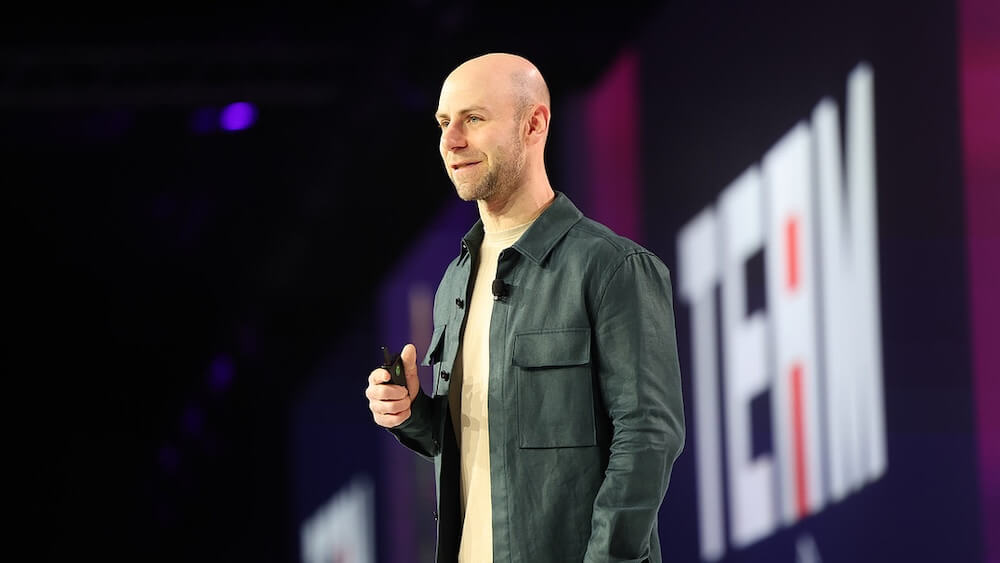
Adam Grant’s CL26 opening keynote session was called ‘Hidden Potential: Unlocking Excellence in Yourself and Others.’ Photo by Jacob Slaton / Whatever Media Group
When the organizational psychologist Adam Grant was in high school, he took inspiration from a diving coach’s assessment that although he wasn’t strong and moved like a Muppet, if he poured himself into the sport, “I could become halfway decent,” Grant told the audience during the opening Main Stage keynote on Sunday evening.
Diving didn’t turn out to be Grant’s calling — the Philadelphia native has been named the top-rated professor at the Wharton School of Management at the University of Pennsylvania for seven years running and is a bestselling author and host of two podcasts — but after two and a half years of training, Grant became a state finalist in diving competitions.
His big takeaway, Grant said, is that everybody has potential: “I didn’t think I could get anywhere near that good — and neither did my teams.” He came to believe, he said, that if he could improve that much in diving, “literally anyone could get better at anything.”
During a 20-minute talk, Grant shared research and insights into what it takes for individuals and leaders to realize the potential in themselves and their teams, including how to think differently about imposter syndrome — one of the things that holds a lot of people back from fulfilling their potential, he said.
When a former student of Grant’s looked at the impact of imposter syndrome on a range of professionals, including financial, medical, and event manager professionals, her research showed that there were benefits to those flickers of doubt about whether or not you are up to a challenge, Grant said. “The more often you felt like maybe you weren’t as good as other people think you are, the harder you worked, the smarter you worked, and ultimately the more value you had, because you felt like there was a gap between where other people expected you to be and where you were.”
 Subscribe to Convene.
Want deep-dive insights on events delivered to your inbox? Sign up for our newsletters.
But you have to be careful not to dwell on your own negative perceptions of yourself — other people see you more objectively and more neutrally, Grant added. One remedy is to create a personal highlight reel of your best work and replay it often — research shows that if you do that, your performance goes up six months later, he said. And don’t wait to act until you think you are ready, he advised, a lesson he learned while struggling to improve his diving. “I thought I needed to feel ready in order to act, but I needed to take the lead in order to feel that I was ready. And I think this has been a lesson at every point in my career where I hesitate to take a risk and go try something new or attempt to realize the potential that I failed to unlock.”
After his talk — which included vintage video highlights of Grant’s high-school dives — the presentation moved to a wide-ranging conversation between the psychologist and Main Stage emcee Holly Ransom on topics including the most valuable kind of feedback, on AI and human ability, and what Grant is currently thinking about most:
Grant on the best kind of feedback: “I think critics are people who basically recognize the worst version and attack. Cheerleaders are people who see us at best, but coaches are what we really need because they’re the people who see our potential and help us become it.”
On AI: AI can generate thousands of ideas and think much more broadly … but what AI is not yet good at is figuring out which of ideas are good. [For now] we still need to be judges. I think there’s only one thing that AI can’t replicate — and that’s experiences. So you all are going to be employed.
On what’s top of mind: “The thing I think about most right now is culture carriers. It’s somebody who, if I can only meet one person [in a workplace] and after just five minutes I get what’s special about the culture if I talk to them. We undervalue them. They’re the people who shape everybody else’s sense of what are our values, what are our norms, what do we stand for.”
Barbara Palmer is Convene’s deputy editor.