 Log In

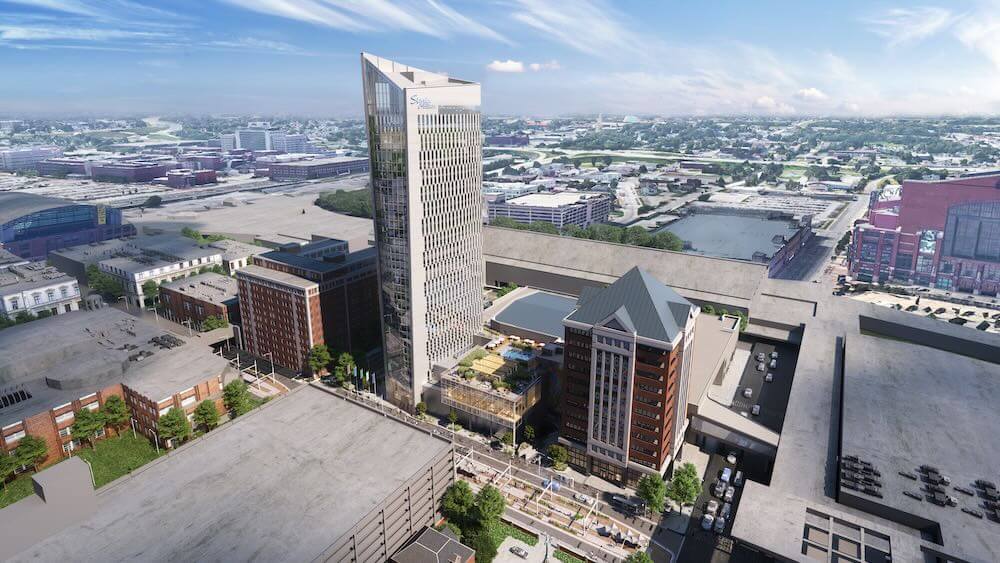
A brand-new 800- room Signia by Hilton is rising across the street from — and connected via pedestrian walkway to — the Indianapolis Convention Center.
Indianapolis has always been a big sports city. Growing up in a small town 45 minutes south of the capital of the Hoosier State, to me the big city felt synonymous with big competition. It was where my parents took me to see the Colts throw touchdown passes at the RCA Dome, the Pacers sink three pointers at Market Square Arena, and the best racecar drivers in the world fly around the Indianapolis Motor Speedway.
I grew up, stopped pretending to be Reggie Miller at our backyard hoop, and moved away. Meanwhile, Indy continued to cement its status as a destination for anyone who loves winners. The NCAA relocated its headquarters to the west side of downtown in 1999. The NFL hosted the Super Bowl at Lucas Oil Stadium in 2012. And in 2024, the WNBA’s Indiana Fever drafted the face of the future of women’s basketball, Caitlin Clark.
During that time, the city has also carved out a niche as a home for crowds that stick around much longer than four quarters. Last year, Indy set a new record for tourism numbers, thanks in large part to its ability to welcome groups such as the 71,000 gaming enthusiasts at Gen Con and 36,000 firefighters at FDIC International. I headed to Indy in the middle of October to experience how the city hosted the annual gathering of the American Academy of Otolaryngology-Head and Neck Surgery (AAO-HNS).
Designing a Fomo-Inducing Experience
When I arrived at Indianapolis International Airport on a Sunday afternoon, it was clear that the city wanted to make sure that the more than 5,400 head and neck surgeons and health-care professionals who traveled here knew the local community was glad they did. Customized digital signage displayed throughout the terminal celebrated the audience, which included representatives from more than 75 countries, and that red-carpet treatment continued in the heart of the convention district, just a 15-minute drive from the airport. As I passed Lucas Oil Stadium where around 67,000 fans were indoors cheering for the Colts, banners welcoming AAO-HNS attendees hung from the streetlight poles. These welcoming touches were arranged by a local org-anizing committee of 25 members of the hospitality industry and the local AAO-HNS chapter. When I checked in to the JW Marriott — the 1,013-room property is fresh off a $15-million renovation — my keycard even included a branded welcome.
“We looked at the airport, public safety, hotels, food and beverage outlets — anything that we thought had a direct touchpoint with the attendees,” Visit Indy CEO Leonard Hoops told me. “I want every doctor who comes to walk away from this place thinking that the people who didn’t come to AAO in Indy missed out.”
In addition to evaluating the experience AAO-HNS stakeholders would have in the city, the committee paid extra attention to the organization’s experience design strategy, which included the debut of a new Wellness Zone in the exhibit hall at the Indiana Convention Center, with areas for breathing exercise classes, compression and eye massage, red light therapy, and an immunity bar. To build on the heightened focus around caring for the mind and body, host hotels turned some of their own meeting spaces into ancillary wellness lounges with soft seating, tea, and calming amenities. And attendees could remain in a relaxed state by not stressing over dinner plans — Visit Indy staff members offered tips on restaurants and activities at a concierge station in the center.
Hoops said this kind of heavy lifting from a local organizing committee is typically reserved for events like the ASAE Annual Meeting & Exposition and the NCAA Final Four — both of which are coming to Indy in 2026 — but AAO-HNS was seen as an equally important piece of business. “We hadn’t secured a lot of surgeon groups historically. When we booked this in 2018, it felt like an early indicator,” he said, that the perception of Indy “was shifting.”
Turning ‘a Tough Sell’ Into a Top Destination
When Hoops took over the reins at Visit Indy in 2011, there were plenty of people who couldn’t find Indianapolis on a map. In fact, Hoops dealt with a wave of skepticism from the local community. “When I got here, some lifelong Hoosiers said, ‘You’re a San Francisco guy,’” he said. “‘We don’t have any oceans and mountains here. This could be a tough sell.’”
I had become one of those Hoosiers years ago. The big city of my youth paled in comparison to the allure of places like New York and Los Angeles, and I told self-deprecating stories about my flyover country roots. I could have used Hoops’ ability to see Indy’s appeal and potential.
“A lot of people told me that Indy is a flat city with a river,” he said. “You know another flat city with a river that’s done just fine? Paris.”
While Hoops jokes that Paris may have a few advantages — a head start of around 2,000 years of collecting art and refining its culture, for example — he spent his early days in Indy carving out unique aspects that would turn this crossroads of America destination into a place giving everyone a reason to stop. On the second day of my visit, I hopped on a bike for a two-wheeled tour of how that flat city can elevate the attendee experience.
I biked to White River State Park, a 250-acre campus that offers planners a variety of convenient off-site venues: The park is located within a mile of the convention center. For an evening of live entertainment, the 6,000-capacity Everwise Amphitheater — host to chart-topping acts throughout the summer — is available for private rentals. The park also includes attractions such as the Indianapolis Zoo, the only triple-accredited zoo, aquarium, and botanical gardens in the country and home to a range of event spaces including the open-air Bicentennial Pavilion for up to 700 guests. At the Indiana State Museum, attendees can explore more than 500,000 artifacts while enjoying private events with a view of the city. When the Society of Independent Show Organizers recently hosted an event at the Eiteljorg Museum — home to a mix of Native American and Western culture next door to the state museum — attendees enjoyed one of Indy’s unique attractions patterned after a city some 4,700 miles away: gondola rides on the canal that stretches along the west side of downtown.
 Subscribe to Convene.
Want deep-dive insights on events delivered to your inbox? Sign up for our newsletters.
In addition to its appeal for groups, Indy is emerging as a leisure destination that gives attendees a lot more to savor. On my first evening, I took an Uber 20 minutes north to the Meridian Kessler neighborhood to sample Southern-inspired dishes from a James Beard Award-winning husband-and-wife team at Root & Bone. My second day included a comfort brunch at local downtown favorite Cafe Patachou and a dinner of perfectly grilled filet at Commission Row, one of the hottest new restaurants of the year, according to Yelp — and home to options for groups, including a full buyout of the basement speakeasy and multiple rooms on the third floor. Each meal backed up Indy’s claim to fame as a culinary capital: Food & Wine recently named it one of “America’s Next Great Food Cities.”
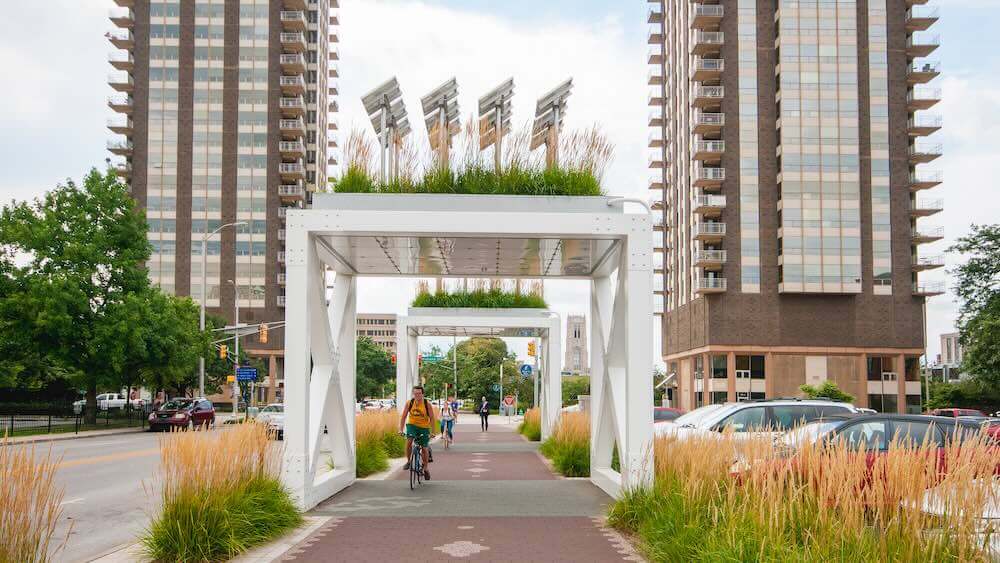
‘Prairie Modules 1 & 2’ on the Cultural Trail are architectural sculptures with tall grass and solar panels — a reference to the city’s agricultural and urban environment.
Building More Space
I traded in my bike helmet for a hard hat, safety vest, and glasses for a tour of a new 800-room Signia by Hilton, which will be another feather in Indy’s cap when it opens in the fall of 2026 just across the street from the convention center. The property will boost the number of rooms connected to the convention center via pedestrian skywalk to more than 5,200 — the most in the country. While the site was home to around 700 construction workers during my visit, by next year planners will be able to accommodate huge crowds on a second-floor ballroom that will span 50,455 square feet. Hoops said that some of the city’s biggest recurring pieces of business have been growing at a pace that demands bigger space, and their latest RFPs specifically included the need for a 50,000-square-foot space — much bigger than the existing ballroom at the convention center. “We had to take care of the biggest existing customers or risk losing them to other cities,” he said.
The new property does more than keep those clients, though. Hoops believes it will position the city to comfortably host two mid-size groups simultaneously between the existing 566,000 square feet of exhibit space at the convention center and another 183,000 square feet at Lucas Oil Stadium that can be converted into exhibit space.
When I took the elevator to the 37th floor of the Signia, I got a bird’s-eye view of some of the $3 billion in development that will further transform the city over the next decade. A new, 170-room Shinola Hotel — the first location for the lifestyle brand outside of its home in Detroit — is scheduled to open in late 2027, along with a 4,000-seat Live Nation concert venue. And there are plans for a 130-room Kimpton Hotel, a 116-room Motto by Hilton, and a 156-room 21c Museum Hotel in the works as well. In addition, between 2030 and 2035, an ambitious, two-phased $600-million plan to redevelop a massive mall into a mixed-use, open-air neighborhood seems like a model for other urban destinations to follow to reimagine their outdated malls.
Indy is also remaking itself as a knowledge hub and investing heavily in the future of patient care. The new IU Health campus — located around 1.5 miles north of the convention center — is one of the biggest health-care construction projects in the country. When the $4-billion project is completed at the end of 2027, the 44-acre campus will include state-of-the-art patient care facilities, along with three clinical institutes for cancer, cardiovascular, and neuroscience that will continue to attract top medical talent — like the more than 35 local IU Health experts who spoke at the AAO-HNS program. The upcoming convention calendar shows that Indy has already won over other leading medical organizations, including American Academy of Family Physicians, American Society of Safety Professionals, and American Society of Plastic Surgeons, who will host annual gatherings here — all of whom cited the convention center and Hilton expansion project as factors that influenced their decision.
On my last night in Indy, I walked four blocks from the convention center to Gainbridge Fieldhouse for a Pacers preseason game. Even though they lost, my mood lifted when I returned to the JW Marriott lobby, buzzing with AAO-HNS participants and Association of Schools Advancing Health Professions (ASAHP) annual meeting attendees, whose conference program was kicking off the following morning.
As I sipped my Old Fashioned, I overheard some of the conversations around me. Some were casually reconnecting with colleagues and others were excitedly discussing the kinds of ideas that will change patient care forever. Nothing second-tier about that.
David McMillin is a former Convene editor and freelance writer.