 Log In


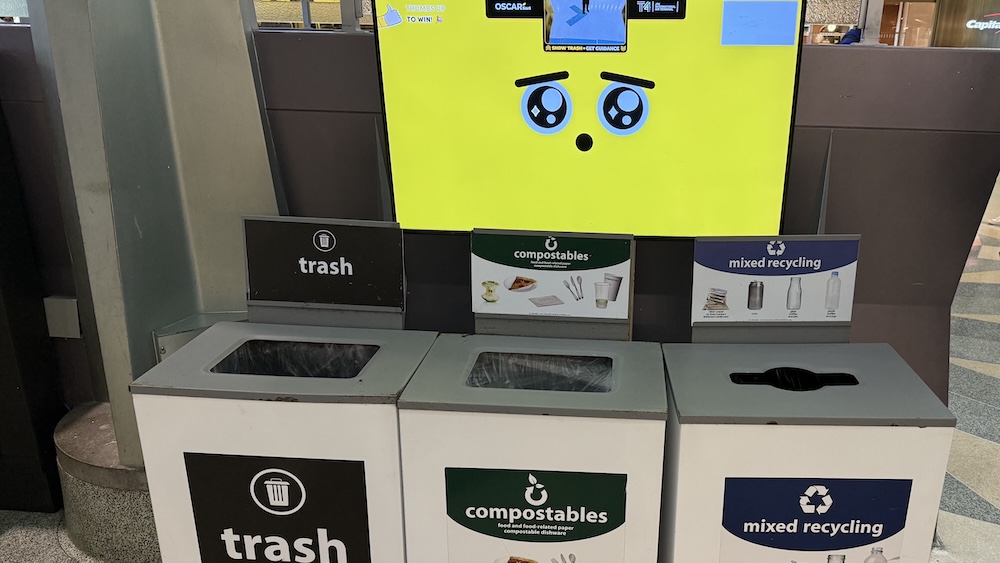
Oscar Sort helps people at airports, stadiums, universities, and other public places recycle correctly by interacting with screens placed above trash and recycling bins.
For event planners and venue managers, reaching sustainability targets can come down to something that happens in just a few seconds and is in the hands of others — the decisions that event participants make about how they discard waste.
Mistakes about what goes into which bin — recycling? compost? trash? — are common and can be costly, since even one item of nonrecyclable material tossed into a recycling bin can result in everything in the bin winding up in a landfill. Over the years, venues and event planners have come up with a variety of ways to help participants out, including installing multilingual signage near bins and recruiting volunteers to offer hands-on guidance.
A few weeks ago, while walking through a terminal at John F. Kennedy International Airport in New York, I came across yet another solution: Oscar Sort, an AI-powered assistant that uses a scanner attached to a screen to identify waste and then directs users to the right bins, which are located just below the screen. Oscar was designed to grab attention — playfully animated eyes and eyebrows danced around a bright yellow background that flashed the message “Got Trash? Show Me” as I approached. I held up a napkin and then half a cookie, and Oscar let me know, with written messages and color-coded pictures, that both could go into the compost bin. It was surprisingly fun, and I learned something — I likely would have tossed the napkin in the trash had Oscar not caught my eye. (I ate the rest of the cookie.)
Created by the Vancouver-based company Intuitive AI in 2017, Oscar Sort can be found in airports around the world, as well as in stadiums, universities, attractions — and, increasingly, at convention centers and events, said Joanna Carson, who works as Intuitive AI’s marketing lead and has a background in event marketing. Oscar was launched into the event world in 2024 at a regional MPI event in San Francisco, where “the positive response made it clear that Oscar Sort was solving a real problem for event planners and venues,” Carson said. Since then, growth has been rapid: Oscar Sort is now on site at events nearly every week, she said. In December, the waste-sorting system will be in five major venues in Las Vegas during Amazon Web Services’ annual 60,000-participant global conference, AWS re:Invent. In addition to events and sponsors that contract with Intuitive AI for specific programs, the company counts two convention centers among its customers that offer Oscar Sort to their own clients — Chicago’s McCormick Place and Toronto’s Enercare Centre.
 Subscribe to Convene.
Want deep-dive insights on events delivered to your inbox? Sign up for our newsletters
How AI Improves Recycling Accuracy
One of the things that makes Oscar work so well for events, Carson said, is that it can be customized to local recycling guidelines as well as to the types of waste that will be circulating at specific events. “We can make sure that Oscar is preprogrammed to know exactly where those things go,” she said. Oscar also can be programmed to use multiple languages, she added, but it uses color and images to direct users to the right bins to remove any language barriers. And Oscar only picks up waste items — not names or any other data about users — and is GDPR compliant, she added.
Carson shared a case study reporting results from the 40,000-participant International Association of Amusement Parks and Attractions (IAAPA) Expo 2024, held at the Orange County Convention Center in Orlando, to demonstrate how AI can improve recycling accuracy. Six Oscar stations were placed throughout the center, where over the course of the event, they diverted 5,480 pounds of food waste from landfills and improved recycling and compost diversion rates by 30 percent. And in August, when Intuitive AI partnered with Coca-Cola to bring Oscar Sort to the Canadian National Exhibition in Toronto, Oscar Sort recorded more than 450,000 engagements and achieved a 90 percent sorting accuracy for cans and bottles over a two-week period, Carson said.
According to Intuitive AI, Oscar Sort boosts recycling accuracy up to 96 percent, increasing diversion rates and reducing CO2 emissions.
Cheeky or Corporate
Oscar Sort also lends itself to sponsorship and exhibitor strategies, including using its gamification features for lead generation, Carson said. Users can interact with the screen beyond receiving waste-sorting directions, by way of trivia questions, games, and other activities. “Every event has such a different tone,” and Oscar’s personality and graphics can change to match the event vibe, Carson said. “For example, when we’re at Global Marketers Week, we are very cheeky because marketers love cheekiness. But when we were at an Workday Rising event a couple of weeks ago, it was branded in a very corporate way. We can white-label Oscar.”
While Oscar Sort can help event planners solve the immediate problem of what participants do with the waste they’re holding in their hands, a big part of Oscar’s mission is getting people excited and engaged with the concept of the power of recycling in general, Carson said. Intuitive AI’s founders, CEO Hassan Murad and COO Vivek Vyas, were robotic engineers who felt the impact of the waste crisis in their homelands — Pakistan and India, respectively — so deeply that they wanted to do something about it, Carson said. Oscar Sort was created to address the problem of recycling contamination due to a lack of knowledge and confusion among the public.
“Recycling is one of the biggest parts of positive climate action — if you double the world’s recycling rate, you can reduce global carbon emissions annually by 25 percent,” Carson said. “Recycling has a terrible reputation, for very good reasons, because every municipality does it differently. So there’s a lot of work to be done, but the idea that recycling doesn’t work in its truest sense is just completely false.”
There have been successes in improving every aspect of recycling along the supply chain, Carson added. “But if we don’t make the right choice at the bin as consumers, every single part along that supply chain — and every part of those improved processes — is in vain.”
Barbara Palmer is Convene’s deputy editor.