 Log In


Communications expert Andrew Brodsky on how to use email to strengthen your connection to others.
We spend, on average, five hours a day reading and responding to work email and texts, according to an estimate cited by organizational behavior expert Andrew Brodsky, Ph.D., in his 2025 book Ping: The Secrets of Successful Virtual Communication. Given that, Brodsky, a management professor at the McCombs School of Business at the University of Texas, has a message about email that may sound counterintuitive: You might want to put more of yourself into it.

Author and professor Adam Brodsky, Courtesy Simon & Schuster.
The challenge, Brodsky told Convene last winter as Ping prepared to launch, “is that, as many of us realize, it’s hard to relay emotion” via email. And we tend, he added, to be poor judges of how well recipients understand the meaning of our emails.
Brodsky, whose Ph.D. research at Harvard Business School looked into how technology alters communication, cited a research study where participants were asked to tap out a song on their desks and to say how confident they were that someone else could guess the name of the song. People who hear the tapping rarely guess the song correctly, but those who tapped them out were “extremely overconfident” that they would, Brodsky said. “When we’re tapping on the desk, we hear the music in our heads … but the other person’s missing information.” In email, “we can feel the emotion as we’re writing it, but the recipient is coming from a different set of assumptions and information and they’re lacking that music or emotions that are in your head as you’re writing it. So it’s much less clear to them.”
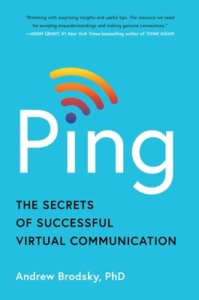
Ping: The Secrets of Successful Virtual Communication, Courtesy Simon & Schuster.
Compounding that is the fact that “positivity ends up getting sucked out of virtual communication,” he said. “Negative emotions tend to get more negative and positive emotions tend to get more neutral in email messages.” It’s especially true in business contexts, where people are anxious and they’re coming at communication from a place of wanting to make sure they don’t make a bad impression, Brodsky added. “That anxiety can bleed through in how messages are interpreted, which can also make them seem more negative than they are, compared to richer modes of communication like video or in person, where you can hear the tone of voice.”
“People are understandably hesitant to take anything other than a very scripted approach to virtual communication,” Brodsky writes in Ping, but “bringing a personal aspect back into virtual communication is key to building trust.” Remind others “that you are more than an anonymous robotic email response,” he advises. And remember, “that when others are communicating with you virtually, they’re staring at a screen, which makes it easy to forget there is an actual human behind that text or video display.”
Is ‘Thanks for the Attachment’ Too Much?
In Ping, Brodsky also addresses the workplace worry of sending too many email replies. “It might feel like you’re annoying the other person by crowding their inbox with a simple ‘Thanks for the attachment,’” he writes. “Virtual communication has made it so easy to get in touch with each other that, paradoxically, sometimes we end up communicating less. Everyone’s inboxes are full, and no one wants to be known as that person who keeps a conversation going after everyone else is finished.”
But in general, he wrote, you should worry less about sending superfluous messages than offending others by seeming to ignore their messages — by replying, it shows that you are “listening.” In a set of research studies of business leaders and employees, leaders who under communicated were rated by employees as less qualified because they were seen as less empathetic, he added. Leaders whose communications were well-calibrated were ranked the highest, but those rated as over-communicators were ranked much higher in terms of leadership than under-communicators. “If you want to build trust, interact more frequently,” he wrote. “When it comes to virtual communication, the tendency to under communicate can reduce trust and weaken relationships.”
Brodsky, however, is not an advocate for adding to already overflowing inboxes. Too much time spent on email cuts into productivity and email interruptions have a substantial negative effect in the office, he writes in Ping. Instead, he advises taking a more thoughtful approach to how we interact, deciding when it makes sense to meet, talk by phone, send an email or text, and adjusting our communication to that channel. “We take much of the nonverbal information and cues that happen face-to-face for granted,” he writes. “When approaching virtual communication, it is vital to be strategic in ways that are unnecessary when communicating in person.”
Barbara Palmer is deputy editor at Convene.