 Log In

Author:
Michelle Russell
A new report from event production company Encore, and events media, research, and consulting firm Boldpush, offers insights based on the survey responses of 447 event professionals. Respondents, one-third of whom are corporate planners, were asked for their perspectives across “the core dimensions of experience design: programming, connection, technology, and trust.”
Their responses, according to its executive summary of “The Experience Design Report,” can be distilled into four main takeaways:
- Connection is No. 1, but programming hasn’t caught up. While planners rank peer networking as the most critical element of event success, only a small number dedicate enough programming to structured connection.
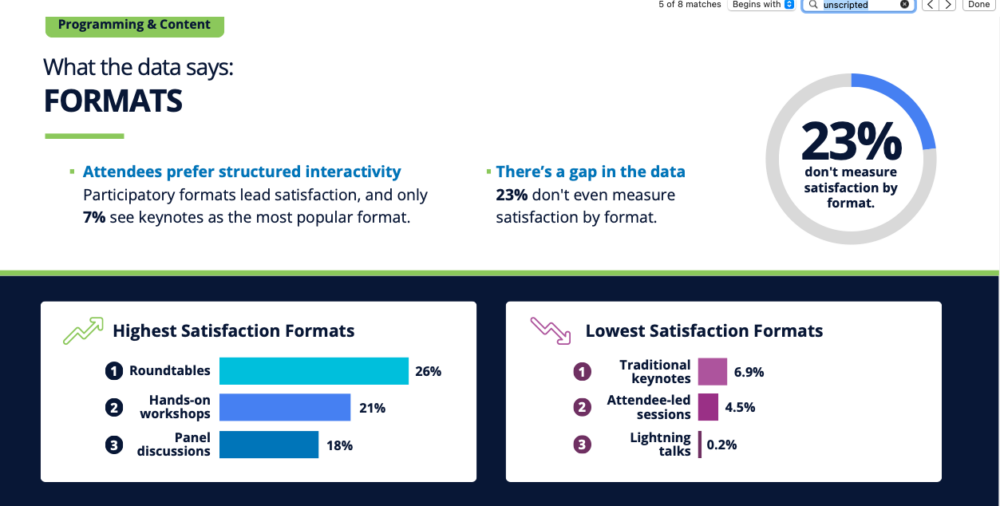
- Participatory formats outperform other session types. Roundtables and hands-on workshops lead participant satisfaction, planners said. Keynotes? Not so much — only 7 percent rank them as the most satisfying elements of the program. But have no fear ….
- The keynote isn’t dying, it’s evolving. Formats are shifting in favor of shorter, multi-perspective, interactive sessions (see above).
- Trust is built through human interaction first. Face-to-face is the No. 1 trust builder. Shared peer experiences follow. Planners need to more intentionally design for human connection.
 Subscribe to Convene.
Want deep-dive insights on events delivered to your inbox? Sign up for our newsletters
Among the other findings:
- Microevents — More than three-quarters of respondents who offer microevents — what Boldpush founder Julius Solaris defined for Convene as small, curated experiences — see a positive registration impact, although one-quarter of survey takers don’t offer them at all. But for all the attention in recent years on promoting wellbeing at events, planner respondents said health and wellness activities are the least in-demand side experiences. Social and entertainment experiences are ranked highest.
- Structured Networking — Nearly half of respondents ranked peer networking as the No. 1 driver of event success, with content following at 43 percent. But only 8 percent dedicate more programming to structured connection while 18 percent leave that entirely to chance. We asked Solaris if “structured connection” was defined in the survey question — curated agendas, networking options organized according to cohorts, for example. He said the survey question was more generic: What percentage of your event programming is explicitly designed for attendee-to-attendee connection (not organic networking breaks)?“It would be fascinating to get that level of insight,” Solaris responded via email, “but that would [require] more qualitative research with 40-50 participants. That level of depth is prohibitive at 447 respondents.”
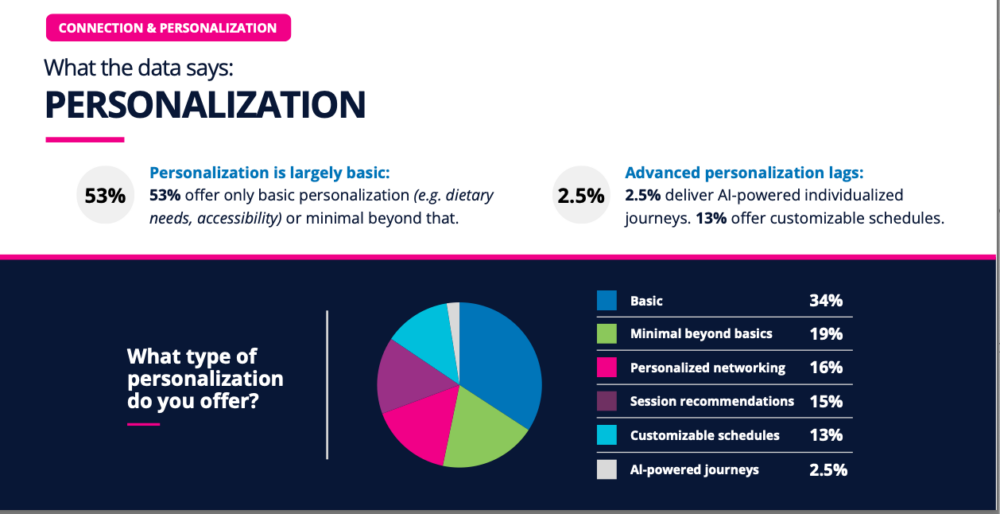
- Personalization — When asked what kind of personalization respondents offer for the participant experience, the majority — 53 percent — offer only basic personalization (like taking dietary and accessibility needs into account). Sixteen percent offer some kind of personalized networking; 15 percent offer session recommendations; and 13 percent provide customizable schedules. Only 3 percent provide AI-powered journeys, which Solaris found shocking. “Why not AI?” he said. “The tech is being built right now. We understood when modern AI came alongthat all the platforms that promised AI before 2022 were selling tagging on steroids. Now those same companies are building better tools. I anticipate a six-month window to see a true breakthrough.”
- Scaling events — According to the research, the top three session formats depend on the size of the event. For events of up to 5,000 participants, roundtables are ranked as the top driver of satisfaction (chosen by 27 percent), followed by hands-on workshops (21 percent); and panel discussions (18 percent). The reverse is true for events of 10,000-plus attendees: panel discussions are ranked the No. 1 driver of satisfaction (29 percent); hands-on workshops remain in second place (again at 21 percent); and roundtables drop to third place (at 18 percent).This insight about panels particularly stood out to Solaris. Panels have gotten a bad rap, he said. “It may look like no one liked the format. If you think about it, though, panels can often deliver short bursts of content at large events in a pretty neat way when well-coordinated. They are also very in demand with sponsorship, which aligns the sponsor to attendee response. Of course, the need to organize and structure thesponsor interaction is obvious, but there is a message in that. Many exhibitions and trade shows are finally understanding that they need to move on from selling real estate.”
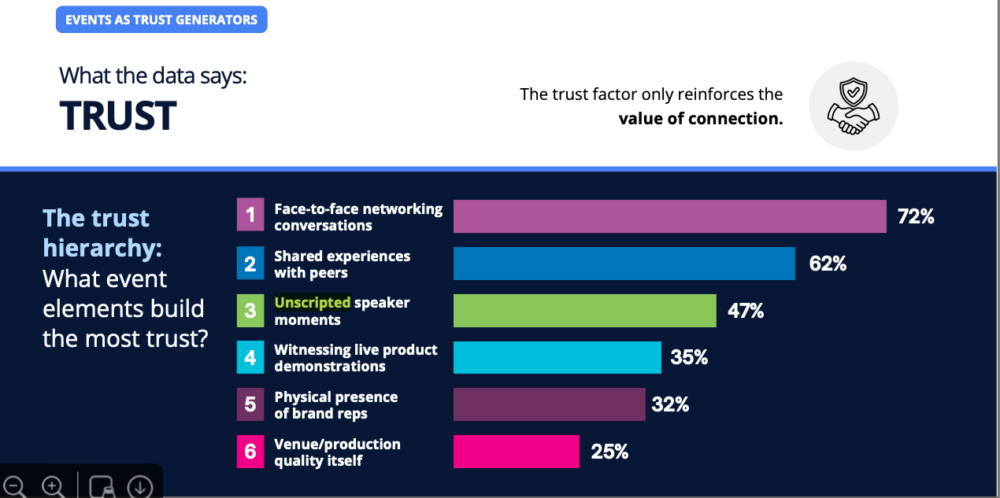
- Trust — When asked what event elements build the most trust, face-to-face networking conversations were ranked first by 72 percent of the event organizer respondents. Shared experiences with peers came in next (62 percent), while unscripted speaker moments was ranked third by nearly half of the respondents. Solaris tied this last data point to “the keynote’s performance. Usually, these are buttoned up and scripted.” But when keynoters are more in the moment and spontaneous, it has big impact. Solaris gave the example of Salesforce CEO Marc Benioff speaking at the software company’s conference: “He goes offstage and off script to engage the audience. Attendees love it.”The more serendipitous aspects of events are best supported by AI, Solaris said, which may initially seem like a contradiction. But he noted that “AI can help us provide just-in-time information more effectively. It can also provide better recommendations on whom we should meet. But if the event is not intentionally designed to create organic, structured opportunities for connection, those unscripted or serendipitous moments will probably never happen. AI gives context; planners have tocreate the space.”
- Biggest gaps and opportunities — Solaris said there were a few findings in the survey results that struck him. The biggest surprise was “the disparitybetween the need for connection and the intentional design of connection moments.” Also of note: How highly the panel session format was ranked in terms of satisfaction, and the lack of personalization efforts to help attendees navigate the event in ways that makes the most sense for them. In fact, Solaris thinks this is the low-hanging opportunity for planners to better meet the evolving needs of their audience. “A personalized agenda,” he said, “will already put you substantially ahead of most of your competition.”
Download the full report here.
Michelle Russell is editor in chief of Convene.