 Log In

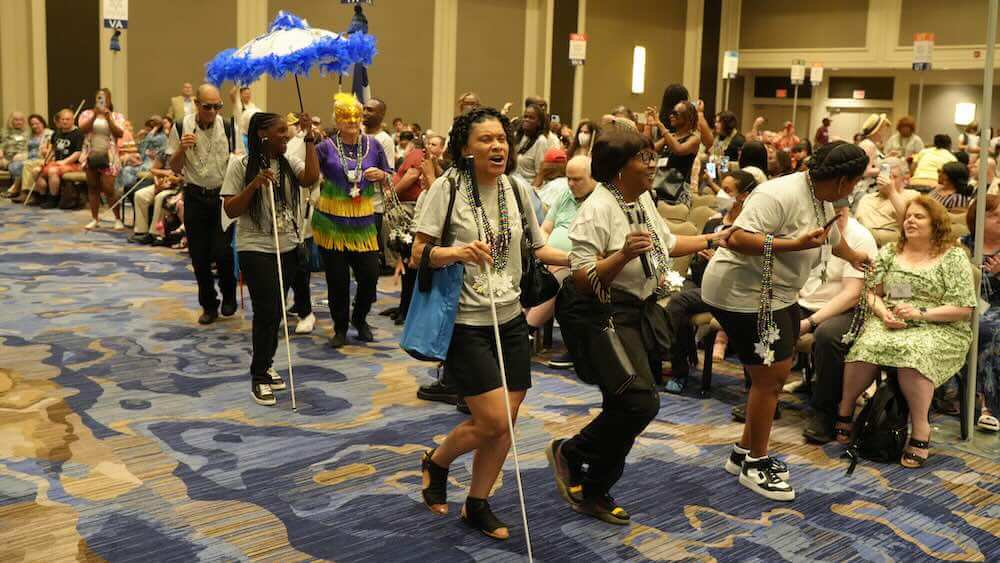
The National Federation of the Blind’s most recent national convention was held in New Orleans. Photo courtesy National Federation of the Blind.
On July 7, the day before the national convention of the National Federation of the Blind (NFB) was scheduled to begin at the New Orleans Marriott, a TikTok labeled “National Blind Convention Disaster in New Orleans,” began amassing thousands of views. The video showed long lines of people with white canes in the hotel’s lobby, accompanied by commentary by its creator, “ethanlivinglife,” describing what he called a “disastrous” start to the conference.
“Since the hotel was so happy to take in their money, you would have assumed that they would have made accommodations for their visitors — they had not,” he said, communicating an “utter lack of respect and lack of preparation,” on the part of the hotel. There were no Braille menus in the hotel’s restaurant and a person with a white cane who appeared to be lost had been seen walking outside the hotel, ethanlivinglife reported, adding that he and friends had spent more than an hour helping people find their rooms. Other TikTok creators posted copycat videos, and commenters piled on, many pointing fingers, not just at the hotel but at the conference’s organizers.
A few days later, I called Chris Danielsen, the editor of NFB’s Braille Monitor, and a spokesperson for the association, to ask if and how NFB had reacted. Danielsen was responding, I discovered, to the TikTok video not as a crisis, but as an opportunity to talk about the needs of the conference’s blind participants.
“I think that the TikTok video makers just had the wrong expectation about how this was supposed to work,” Danielsen said. “It would probably shock those content makers to understand that it was a convention primarily run by blind people.” He said he chalked up the criticism “not so much to the idea of people wanting to give bad publicity to a convention as much as just what we deal with all the time — which is the misunderstanding about what it looks like and what it should look like for a group of blind people to gather.”
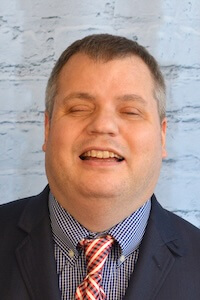
Chris Danielsen, spokesperson for the National Federation of the Blind. Photo courtesy National Federation of the Blind.
Speaking as a blind person himself, Danielsen said, “you go out on the street and everybody seems to think that you’re perpetually lost even though you’re not.” At NFB, “we believe very strongly in the independence of blind people. And so we don’t operate from the presumption that everybody needs assistance.”
Danielsen was unaware of the TikTok — which had been posted as participants arrived a day early — until local news media showed up at the hotel to report on the situation, he said. To all the media who asked, “we told them that the [New Orleans] Marriott — where the NFB’s national convention also was held in 2022 — was doing everything that we had asked or expected them to do,” he said. NFB had provided training, including asking the Marriott to help when conference participants asked for it, which they did, Danielsen said. “The rest is up to us and how we organize ourselves as a group of blind people having a convention — which we’re pretty experienced at. This was our 85th National Convention.”
NFB tried to make things easy for the 2,600 participants at its conference, Danielsen said, just as any organizer would. Staff had brought Braille menus with them to the convention and NFB produces the convention program both in Braille and in audio formats. Ambassadors — who, Danielsen said, “are blind people, by the way” — are posted as “talking signs” throughout the convention venue, particularly in areas that are expected to be crowded, to keep everybody moving. “It’s not that different than a convention of sighted people, where someone may be wearing a badge that invites conference participants to ask for information,” Danielsen said. “The only real difference at our convention is we’re not using sight cues, we’re using non-visual cues.
“I’m not going to claim that there weren’t problems — anytime you have a convention that large, you’re going to have check-in lines and wayfinding issues,” he said. And elevators are a perennial challenge — “we’ve got a lot of people trying to use the elevators. And during particularly crowded times, I know both our ambassadors and Marriott staff were helping with that and making sure that everything was running smoothly.”
The Most Important Thing
What should conference organizers know about planning for blind participants? It’s not unlikely “that a blind person would show up at Comic Con or at any other convention that you can imagine — blind people are a cross-section of society, and we have as many different interests as any other group of people,” Danielsen pointed out. Since conventions are often held in hotels or other public venues covered by the Americans with Disabilities Act (ADA) and already — “hopefully,” he said — have Braille signage, venue accessibility is usually not an issue.
The most important thing to do is make sure that information about the event, including the conference website and agenda, is available in accessible formats, he said. “And the easiest way for most organizers to do it is just to make sure that their website complies with the [Web Content Accessibility Guidelines (WCAG)] standards that make websites accessible to blind people who use screen reader technology,” he said. (See “Building Digital Trust” below.) Created by the World Wide Web Consortium, WCAG has been used to meet requirements for both the ADA and the European Accessibility Act (EAA).
As far as responding directly to the outrage heaped on conference organizers on social media goes, Danielsen referenced a saying: “Don’t feed the trolls.” Sprinkled in among the many comments from sighted people were those from conference participants, both refuting the criticism and complaining about crowds, as well as showing support for the way the event encourages self-reliance: “I’ve been to several of those conventions,” wrote a poster named Marquita. “If you look at it with a different eye, you will see that it promotes independence.”
 Subscribe to Convene.
Want deep-dive insights on events delivered to your inbox? Sign up for our newsletters.
Building Digital Trust
Frank Wächter, senior digital marketing manager at Congrex Switzerland, a conference management company, recently led an initiative to update the company’s website to comply with the requirements of the European Accessibility Act (EAA) — and meet a deadline. The EAA, which focuses on general digital accessibility and is a directive of the European Union, which took effect in 2019, became mandatory on June 28, 2025 for most digital services in the EU and for those serving EU-based customers.
The standards are technical — based on the WCAG (Web Content Accessibility Guidelines) but all events professionals should care about them, Wächter told Digital Media Editor Magdalina Atanassova on the Convene Podcast. “Accessibility barriers can make even basic things like reading event information or completing a form really frustrating for some users. If your digital touchpoints aren’t accessible, you’re excluding people before they even get to your event.”
The EAA covers websites as well as “online booking systems, registration tools, basically all the digital things your audience interacts with,” Wächter said, and requires making them accessible to all users, including those who are blind or have limited vision. This includes ensuring that its pages have such features as sufficient color contrast, navigable headings, clear links, and text that can be resized or read by screen readers.
Wächter’s biggest takeaway was an emotional rather than technical insight: It was “how deeply accessibility connects to trust,” he told Atanassova. “When people can navigate your site or your app or your forms — whatever — with ease, they feel included. The challenge here is getting teams to move past the idea that accessibility is just a checkbox or an extra. It needs to be part of the process from the very start.”
Barbara Palmer is Convene’s deputy editor.
On the Web
- Find the “Accessibility Guide to Event Websites” at bit.ly/WCAG_guide.
- Read more about the European Accessibility Act.
- Find the Convene Podcast at pcma.org/convene/podcast/.