 Log In


Illustration by JooHee Yoon
When it comes to tackling food waste at evests, minor reductions can make a major potential long-term impact. One of the U.S. Food Waste Pact study’s pilot sites showed a projected annual savings of nearly 3,000 pounds of food waste and more than $40,000 in food costs after the venue’s culinary team reduced portion sizes for plated and family-style meals after observing the group’s consumption habits. The specific reductions were made up of small adjustments, including:
- Reducing salad dressing vessels from two to one per table
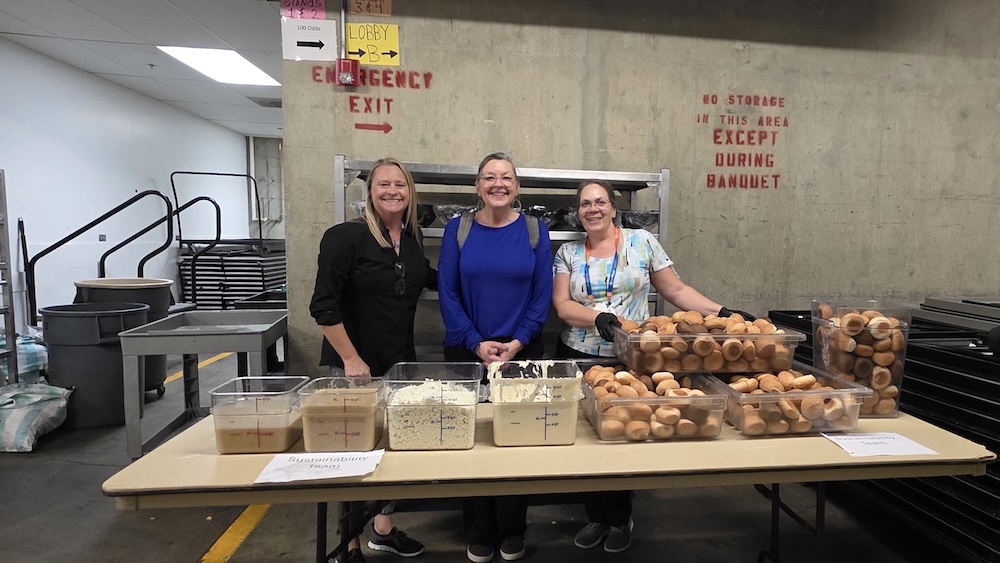
- Serving eight rolls per 10-person table, rather than 12
- Reducing 216 servings of Impossible Burger to nearly zero, based on guest
consumption - Consolidating two separate pasta side dishes into one gluten-free option
Across the board, the new study showed that portion sizes are generally just too large — an issue that the U.S. Food Waste Pact has created a toolkit specifically for venues, including a calculator to help with measuring and standardizing portion sizes. “I think we found that out of the six pilot sites, only one [venue] had recorded specs that could be used for an event,” WWF’s Tara Dalton said. Using a calculator, she said, will help verify whether the kitchen is making the right amount of chicken, for example, to avoid overpreparing, “because that seems to just be a very common challenge.”
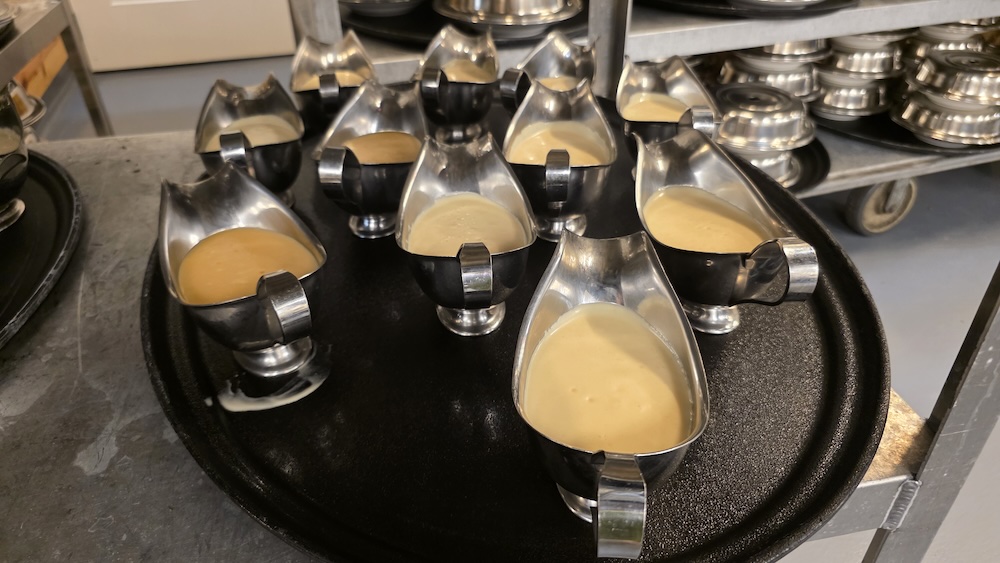
Reducing the number of salad-dressing vessels on each table is a great way to reduce consumption. Photo courtesy ReFED.
A Checklist for Planners
“Every event is kind of different,” WWF’s Tara Dalton said, which is one reason the guidelines created by the U.S. Food Waste Pact encourage planning from the very beginning of an event lifecycle. That includes collecting demographic data to determine portion sizes and menu choices, surveying attendees to understand special diet preferences, and beyond. Below, we’ve summarized a selection of those guidelines and tips from the study and accompanying toolkit specifically for planners.
- Make food waste prevention and recovery part of the agenda and pre-planning sessions. When reaching out to venues, ask about their food waste diversion/donation partners and if they use digital tracking tools, like Leanpath or Winnow, to capture data on food production, recovery, and disposal. Communicate expectations from the start, even in RFPs.
- Ask the chef/culinary team to design menus that are mindful of portion control, commonly overproduced or overserved food items (like bread rolls), and the overall goal of reducing food waste.
- Consider and communicate in advance how real-time adjustments — stopping refills or shifting service according to guest flow, for example — should be handled on site.
- During the event, ask staff to track waste through photo audits or visual logs to review after the event to identify recurring patterns.
- Request a post-event summary detailing production, consumption, surplus, donation, and composting and review for future forecasting and menu planning.
Access U.S. Food Waste Pact’s comprehensive food waste prevention guidelines for both planners and venues here.
‘Our No. 1 Expense’
Tracy Stuckrath, founder of thrive! meetings & events and host of the “Eating at a Meeting” podcast, knows all about the cognitive dissonance around food cost and food waste. “We’re not really thinking about it,” she said during her Convene Podcast interview, “but [F&B] is our No. 1 expense.”
Instead of falling back on the same-old, standardized menus and outdated head counts, Stuckrath said it’s up to planners to “pay attention and look at the accuracy of your numbers.” An example: An event client of Stuckrath’s insisted on ordering enough food for all 450 attendees for their closing lunch at a destination on the West Coast. But when Stuckrath checked the hotel pickup, she noticed that most of the attendees lived on the East Coast. Knowing that most would fly out early that morning to avoid taking the redeye, they ended up cutting that number in half.
A Chef’s Perspective
Andrew Cooper, executive chef at La Quinta Resort & Club in Greater Palm Springs, California, and Pyramid Global Hospitality’s 2025 Manager of the Year, has made sustainability a main ingredient in his kitchens, which frequently serve events and conferences with upwards of 1,000 attendees.
During his recent interview on the Convene Podcast, Cooper shared that he is working on providing zero-waste menus for events and explained how he prevents overproduction and excess food waste at buffets. With the La Quinta property spanning 45 acres and nearly 200,000 square feet of meeting space, that’s no easy logistical feat. Cooper asks his chefs to monitor buffets — often placed at various spaces spread throughout the property — for better and immediate insight on flow and demand. As soon as the last person moves through a buffet, production is stopped. Leftover food is repurposed and reused for other events.
“It’s all [about] talking to one another, communicating,” he said. “But everything you think about has to become [about] money now, with everything going up, tariffs going up. It puts a huge strain on us. But being able to find ways … to stay local and utilize everything and maximize everything, and in the end, making sure that the guest has a great time is a win-win for everyone.”
Further Reading
Read the full report, “Low-Waste Events: Measuring & Reducing Food Waste in Events,” and accompanying materials produced by the U.S. Food Waste Pact, with support from Astrapto Consulting and InvestHER Strategies, here.
The World Wildlife Fund (WWF) and American Hotel and Lodging Association have created a toolkit on food waste reduction specifically for hotels.
Convene previously covered high-tech solutions to help tackle food waste.
Jennifer N. Dienst is senior editor of Convene.
 Coming to the Table
This article and those listed below are part of Convene’s April 2026 issue cover and CMP Series story package.
Coming to the Table: How the Events Industry Is Tackling Food Waste